
What is RTL Design and why is it important?
What Is RTL Design?
RTL Design (Register Transfer Level Design) is the process of describing a digital circuit in terms of how data moves between registers and how that data is processed by combinational logic.
RTL provides an abstraction level between the high-level functional specification and the actual gate-level implementation. Designers commonly use HDL (Hardware Description Language) such as Verilog, System Verilog, or VHDL to describe the required hardware behavior.
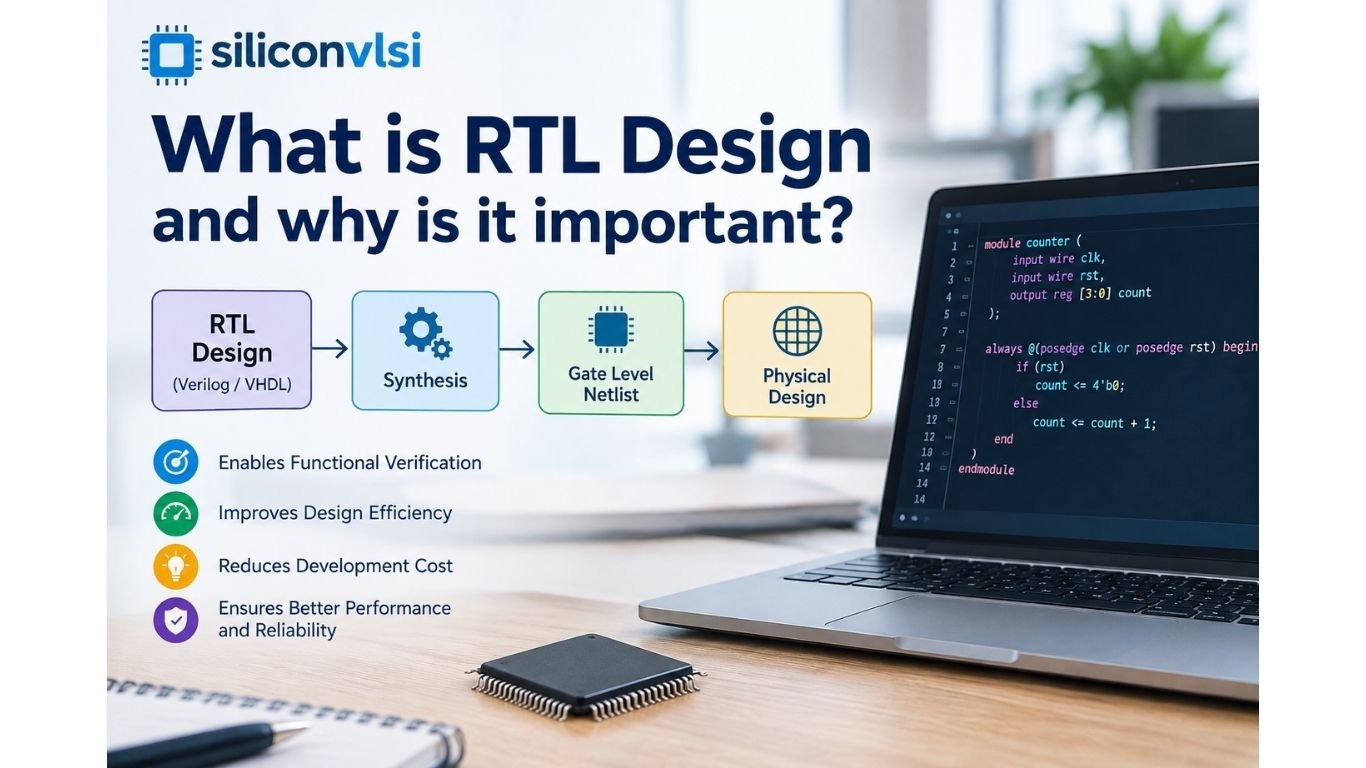
For example, an RTL description can specify that data should be captured by a register on a clock edge, processed by an arithmetic circuit, and then transferred to another register.
Why Is RTL Design Important?
RTL Design is important because it provides a structured way to describe complex digital systems before they are converted into gates and eventually implemented in silicon.
It helps designers:
- Define the intended hardware behavior clearly.
- Describe data movement between registers.
- Design and verify complex digital systems.
- Simulate functionality before physical implementation.
- Synthesize RTL code into logic gates.
- Identify design problems early in the development process.
- Support communication between different stages of the hardware design flow.
How Does RTL Design Work?
A simplified RTL design flow can be represented as:
Specification → RTL Design → Simulation → Synthesis → Gate-Level Netlist → Physical Design → Fabrication
At the RTL stage, the designer describes the required logic and sequential behavior using an HDL.
For example, a simple register can be described in Verilog as:
always @(posedge clk) begin
    q <= d;
end
This RTL description represents a register that captures the value of d on the active edge of clk.
RTL Design and Registers
Registers are one of the most important elements in RTL design.
A typical synchronous digital circuit can be viewed as:
Register → Combinational Logic → Register
The first register stores data, the combinational logic processes it, and the next register captures the resulting data on a clock edge.
This register-transfer model is the foundation of RTL design.
RTL Design vs Gate-Level Design
RTL and gate-level design describe hardware at different abstraction levels.
| Feature | RTL Design | Gate-Level Design |
|---|---|---|
| Abstraction | Higher | Lower |
| Description | Registers and logic behavior | Logic gates and cells |
| Typical languages | Verilog, SystemVerilog, VHDL | Verilog/netlist |
| Design complexity | Easier to manage | More detailed |
| Main purpose | Describe intended hardware | Represent synthesized implementation |
| Human readability | Relatively high | Lower |
RTL allows designers to focus on the intended functionality without manually specifying every individual logic gate.
RTL Design in the VLSI Design Flow
RTL is a key stage in the digital VLSI design process.
After RTL coding, designers typically perform functional verification to check whether the design behaves as expected. The verified RTL is then synthesized into a gate-level netlist using a target technology library.
The resulting netlist can move into the physical design stages, including:
- Floorplanning
- Placement
- Clock Tree Synthesis (CTS)
- Routing
- Static Timing Analysis (STA)
- Physical verification
- Signoff
This makes RTL design an important bridge between system-level requirements and physical chip implementation.
RTL Design and Verification
Writing RTL is only one part of the process. The RTL must also be verified to ensure that it correctly implements the specification.
Common verification activities include:
- Simulation
- Testbench development
- Assertions
- Functional coverage
- Formal verification
- Debugging
SystemVerilog is widely used for both RTL design and verification because it provides constructs for describing hardware as well as verification environments.
RTL Design Example
Consider a simple 2-to-1 multiplexer:
assign y = sel ? b : a;The RTL describes the required relationship between a, b, sel, and y.
During synthesis, the synthesis tool can convert this RTL description into an appropriate gate-level implementation using cells from the target technology library.
The designer therefore describes what hardware behavior is required, while synthesis determines an implementation using the available library cells.
Advantages of RTL Design
RTL design provides several important benefits:
- Higher-level hardware description
Designers can describe complex digital systems without manually drawing every gate. - Simulation before implementation
Functional behavior can be tested before synthesis and physical implementation. - Synthesis support
Synthesizable RTL can be converted into a gate-level netlist. - Better design productivity
Large designs can be developed and maintained more efficiently than manually creating gate-level circuits. - Technology flexibility
Well-written RTL can generally be synthesized for different target technologies, subject to design constraints and available libraries. - Early verification
Functional problems can be identified before expensive physical implementation steps. - Scalability
RTL methodologies are suitable for designs ranging from relatively small blocks to large SoCs.
RTL Design vs Software Programming
RTL code may look similar to software code, but it represents hardware rather than a sequence of software instructions.
For example, multiple RTL statements may describe hardware that operates concurrently. Clocked RTL describes how registers store and transfer data, while combinational RTL describes logic relationships between signals.
Understanding this difference is essential when learning Verilog, SystemVerilog, or VHDL.
Common RTL Design Considerations
A good RTL design should consider more than just functional correctness. Designers also need to consider:
- Clocking
- Reset behavior
- Timing
- Area
- Power
- Resource utilization
- Synthesizability
- Coding style
- Verification requirements
Poor RTL coding can result in unnecessary hardware, timing problems, increased power consumption, or difficult verification.
Frequently Asked Questions
What does RTL stand for?
RTL stands for Register Transfer Level. It describes how data moves between registers and how combinational logic processes that data.
Which languages are used for RTL Design?
Common HDL languages include Verilog, SystemVerilog, and VHDL.
Is RTL Design part of VLSI?
Yes. RTL design is an important stage of the digital VLSI design flow, occurring before synthesis and physical implementation.
Is RTL code converted into gates?
Yes. Synthesizable RTL is processed by a logic synthesis tool, which produces a gate-level netlist based on the target technology library and design constraints.
Is RTL Design the same as physical design?
No. RTL design describes the intended digital hardware behavior, while physical design determines how the synthesized logic is physically implemented on the chip.
Conclusion
RTL Design provides a practical way to describe and develop digital hardware using registers, combinational logic, and clocked behavior. It plays an important role in the VLSI flow because RTL can be simulated and verified before being synthesized into gates and taken through physical implementation.
For anyone learning digital VLSI, Verilog, SystemVerilog, or ASIC design, understanding RTL is one of the fundamental steps toward understanding the complete digital chip-design process.