

Velocity Saturation in MOSFET: 7 Important Short-Channel Effects
Velocity saturation is an important short-channel effect in MOSFETs that causes transistor behavior to deviate from the traditional long-channel model.
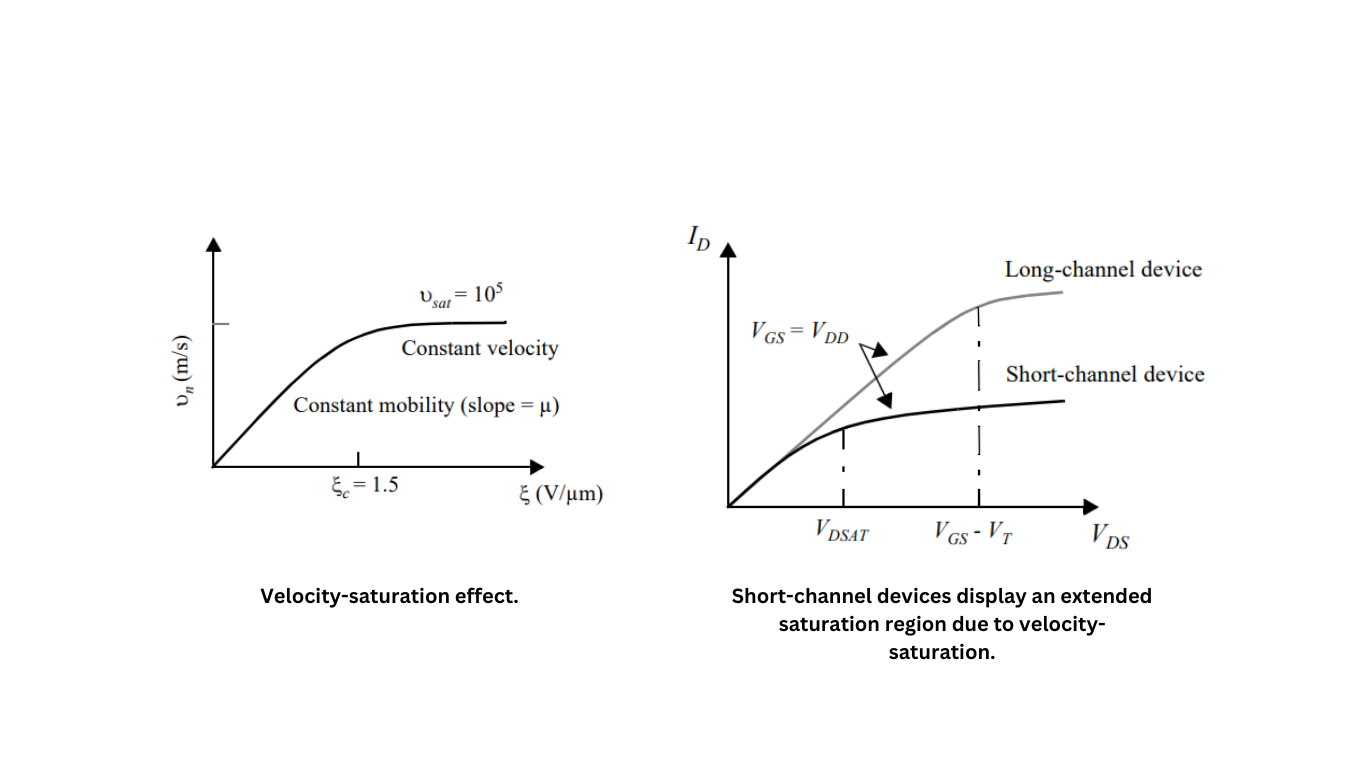
In a long-channel MOSFET, carrier velocity is approximately proportional to the electric field at moderate field strengths. However, when the electric field becomes sufficiently high, carriers experience increased scattering and their velocity approaches a maximum value called the saturation velocity.
This effect becomes particularly important as MOSFET channel lengths become smaller in modern VLSI technologies.

What Is Velocity Saturation?
In a MOSFET, electrons or holes move through the channel under the influence of an electric field.
At relatively low electric fields, carrier velocity can be approximated by:
v = μE
where:
- v = carrier drift velocity
- μ = carrier mobility
- E = electric field
This relationship means that increasing the electric field increases carrier velocity.
However, this relationship does not continue indefinitely.
At a sufficiently high electric field, carriers undergo increased scattering. Their velocity approaches a maximum value known as the saturation velocity.
Therefore:
At low electric field → velocity increases approximately linearly with E
At high electric field → velocity approaches saturation
This phenomenon is called velocity saturation.
Why Does Velocity Saturation Occur in Short-Channel MOSFETs?
The longitudinal electric field in the MOSFET channel can be approximated as:
E ≈ VDS / L
where:
- VDS = drain-to-source voltage
- L = channel length
As the channel length decreases, the same drain voltage produces a much larger electric field.
For example, reducing the channel length while maintaining a similar supply voltage can significantly increase the electric field along the channel.
As a result, carriers can reach velocity saturation even at relatively modest drain voltages.
This is one of the important reasons why short-channel MOSFETs cannot always be accurately described using traditional long-channel equations.
Critical Electric Field
Velocity saturation begins when the electric field approaches a critical value at which carrier velocity no longer follows the simple linear relationship.
The exact critical field depends on factors such as:
- Carrier type
- Semiconductor material
- Temperature
- Crystal orientation
- Device structure
- Process technology
For silicon, typical textbook values are on the order of 10⁶ V/cm for the onset of high-field effects, although the exact value depends on the conditions and model being used.
The saturation velocity is also material- and carrier-dependent. For silicon, electron saturation velocity is commonly approximated on the order of 10⁷ cm/s.
Note: The original article’s numerical value of approximately 10⁵ m/s is reasonable as an order-of-magnitude representation of carrier saturation velocity, but the exact value should not be treated as universal.
Impact of Velocity Saturation on MOSFET Behavior
Velocity saturation changes several important characteristics of a short-channel transistor.
1. Lower Saturation Voltage
For a long-channel MOSFET, the simplified saturation condition is:
VDS ≥ VGS − VTH
Therefore, the traditional model gives:
VDSAT ≈ VGS − VTH
In a short-channel device affected by velocity saturation, the transistor can enter saturation at a lower drain-source voltage.
Thus:
VDSAT < VGS − VTH
in the simplified high-field picture.
This is an important difference between long-channel and short-channel behavior.
2. Drain Current Becomes More Nearly Linear With Overdrive
For a long-channel MOSFET operating in saturation, the basic square-law model gives:
ID ∝ (VGS − VTH)²
With velocity saturation, carrier velocity becomes limited by the saturation velocity. As a result, the drain current becomes approximately proportional to the overdrive voltage:
ID ∝ (VGS − VTH)
A simplified velocity-saturation model can therefore be expressed as:
ID ≈ W · Cox · vsat · (VGS − VTH)
where:
- W = transistor width
- Cox = gate-oxide capacitance per unit area
- vsat = carrier saturation velocity
- VGS − VTH = gate overdrive voltage
The exact current expression depends on the device model and operating conditions.
3. Reduced Current Compared With the Long-Channel Square-Law Prediction
If a long-channel square-law equation is applied to a very short-channel transistor without considering high-field effects, it can overestimate the transistor’s current.
Velocity saturation limits the carrier velocity and therefore changes the relationship between gate voltage and drain current.
This is why short-channel transistor models need additional physical effects beyond the basic square-law model.
4. Channel-Length Modulation
Increasing VDS can cause the drain depletion region to extend further into the channel.
The effective conducting channel becomes shorter, which can increase drain current even after the transistor has entered saturation.
This phenomenon is called channel-length modulation (CLM).
Velocity saturation and channel-length modulation are different effects, although both become important in short-channel MOSFET analysis.
- Velocity saturation → limits carrier velocity at high electric fields.
- Channel-length modulation → changes the effective channel length as VDS increases.
Velocity Saturation vs. Channel-Length Modulation
| Parameter | Velocity Saturation | Channel-Length Modulation |
|---|---|---|
| Main cause | High longitudinal electric field | Drain depletion-region expansion |
| Primary effect | Limits carrier velocity | Reduces effective channel length |
| Important in | Short-channel devices | Both, but increasingly important in short channels |
| Effect on ID | Changes current-voltage relationship | Causes ID to increase with VDS in saturation |
| Related parameter | Saturation velocity | Effective channel length |
Both effects should be included when analyzing realistic short-channel MOSFETs.
Mobility Degradation
Another important effect in MOSFETs is mobility degradation.
Carrier mobility near the semiconductor-oxide interface can be lower than the bulk mobility because of the strong vertical electric field generated by the gate.
As the gate electric field increases, carriers experience increased scattering near the interface.
Therefore:
Higher vertical electric field → lower effective mobility
This is different from velocity saturation.
Velocity Saturation vs. Mobility Degradation
Velocity saturation primarily concerns the longitudinal electric field along the channel and the limiting of carrier velocity.
Mobility degradation is strongly associated with the vertical electric field produced by the gate and the resulting reduction in effective mobility.
Both effects influence the current of modern MOSFETs.
Why Is Velocity Saturation Important in Modern VLSI?
As CMOS technology scales, transistor channel lengths become increasingly small.
At the same time, supply voltages have not always scaled proportionally with channel dimensions.
Consequently, the electric field inside the channel can become very large.
This makes high-field effects such as velocity saturation increasingly important.
Velocity saturation influences:
- Transistor drive current
- Propagation delay
- Switching speed
- Power consumption
- Transconductance
- Analog gain
- Output resistance
- Digital circuit performance
Therefore, it is an important consideration in modern VLSI circuit design and MOSFET modeling.
Why Use Long-Channel MOSFETs for High-Impedance Current Sources?
Long-channel transistors are often preferred when a high-output-impedance current source is required.
One reason is that increasing channel length generally reduces the relative influence of channel-length modulation.
In a simplified MOSFET model:
ID ≈ ID,sat(1 + λVDS)
where λ represents the channel-length-modulation parameter.
A smaller λ means that drain current changes less with VDS.
Therefore:
Smaller λ → higher output resistance
and:
Higher output resistance → better current-source behavior
This is why analog designers often use relatively long-channel devices when high output impedance is important.
However, the complete output resistance of a modern MOSFET can also be affected by other short-channel effects, so CLM alone does not fully describe practical devices.
How Does VDS Affect the Effective Channel Length?
As VDS increases, the depletion region associated with the drain-body junction expands.
The point where the inversion channel terminates moves toward the source.
Consequently, the effective channel length becomes smaller.
This produces an increase in drain current and contributes to channel-length modulation.
It is important not to confuse this mechanism with velocity saturation:
Velocity saturation → carrier velocity is limited by high electric field
Channel-length modulation → effective channel length decreases
Both may occur simultaneously in a short-channel MOSFET.
Long-Channel vs. Short-Channel MOSFET
| Feature | Long-Channel MOSFET | Short-Channel MOSFET |
|---|---|---|
| Carrier velocity | More nearly follows μE at moderate fields | Can approach saturation velocity |
| Current relationship | Approximately square-law in basic model | More nearly linear with overdrive in velocity-saturated regime |
| Saturation voltage | Approximately VGS − VTH | Can be lower |
| Mobility effects | Important | Often more significant |
| Channel-length modulation | Usually weaker | Generally stronger |
| High-field effects | Less dominant | More important |
| Basic square-law model | More useful | Less accurate by itself |
Common Questions About Velocity Saturation
What is velocity saturation in a MOSFET?
Velocity saturation occurs when carriers in the MOSFET channel reach a maximum practical drift velocity because of high electric-field scattering. Further increases in electric field produce little additional increase in carrier velocity.
Why is velocity saturation important in short-channel MOSFETs?
Shorter channels produce larger electric fields for a given drain voltage. Therefore, carriers can reach their saturation velocity more easily.
Does velocity saturation increase or decrease transistor current?
It changes the current-voltage relationship and limits the benefit that would otherwise be predicted from continuously increasing carrier velocity. A long-channel square-law model can therefore overestimate current if high-field effects are ignored.
What is VDSAT?
VDSAT is the drain-source voltage associated with the onset of saturation. In short-channel devices affected by velocity saturation, it can be smaller than the classical long-channel value VGS − VTH.
Is velocity saturation the same as channel-length modulation?
No.
Velocity saturation limits carrier velocity because of a high electric field, whereas channel-length modulation occurs because increasing VDS changes the effective channel length.
Why are long-channel devices useful for high-impedance current sources?
Long-channel devices generally exhibit weaker channel-length modulation, resulting in a smaller dependence of drain current on VDS and therefore higher output resistance.
Is mobility degradation the same as velocity saturation?
No. Mobility degradation is primarily associated with increased vertical electric field and interface scattering, while velocity saturation is associated with high longitudinal electric field and the limiting of carrier velocity.
Key Takeaways
- Velocity saturation is an important short-channel MOSFET effect.
- Carrier velocity does not continue increasing linearly with electric field indefinitely.
- At high electric fields, carrier velocity approaches a saturation value.
- Shorter channel lengths produce stronger electric fields for a given VDS.
- Velocity saturation can cause VDSAT to become lower than VGS − VTH.
- The drain current can become approximately linear rather than square-law with gate overdrive in the velocity-saturated regime.
- Mobility degradation and channel-length modulation are separate effects that also influence short-channel MOSFET behavior.
- Long-channel devices are often preferred for high-output-impedance current sources because channel-length modulation is weaker.