
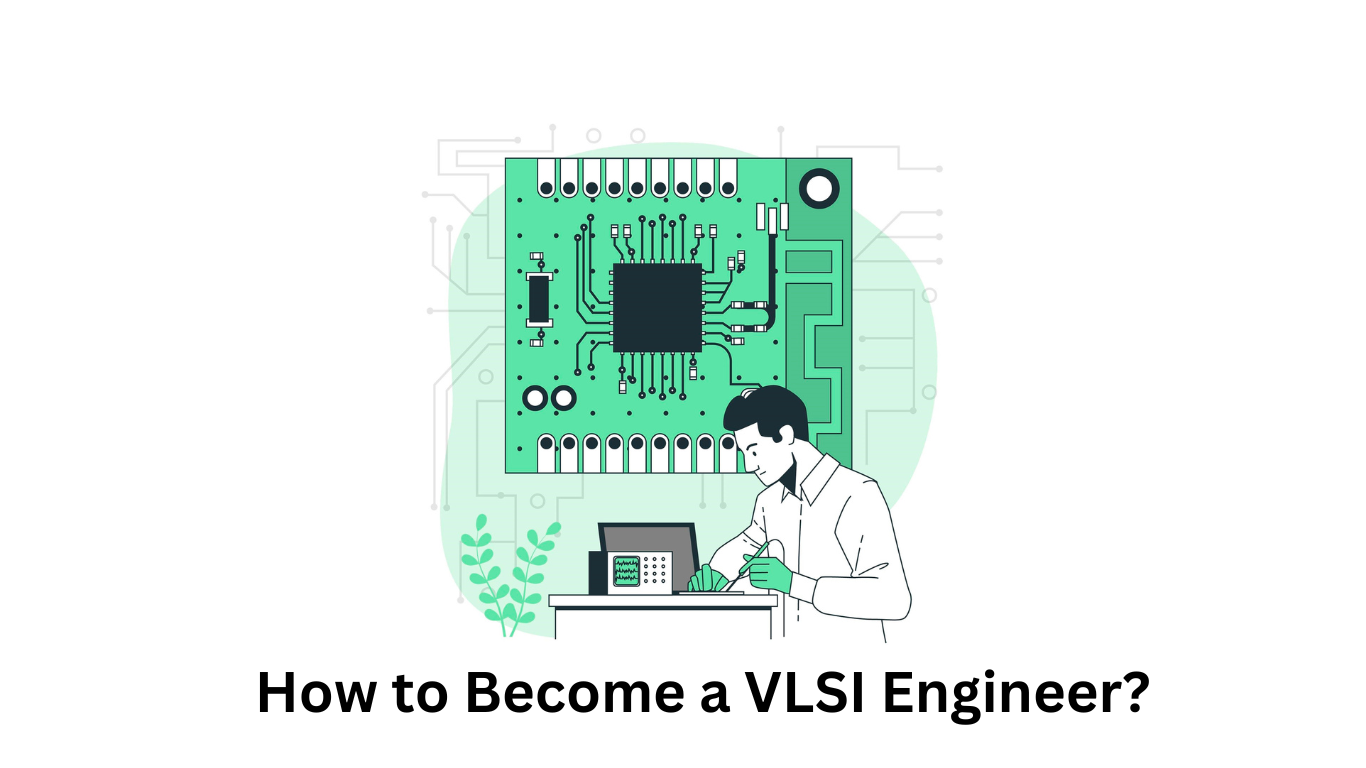
How to Become a VLSI Engineer
How to Become a VLSI Engineer: 10 Essential Steps for a Successful Career
VLSI (Very Large Scale Integration) is one of the most important areas of semiconductor and electronics engineering. From smartphones and computers to electric vehicles, artificial intelligence systems, and communication equipment, modern electronic products depend on integrated circuits designed using VLSI technology.
If you are an electronics, electrical, or computer engineering student and are interested in chip design, how to become a VLSI engineer is an important question to explore. The good news is that you do not need to learn everything at once. A strong foundation in electronics, followed by practical knowledge of design tools, hardware description languages, and VLSI methodologies, can help you build a career in this field.
This guide explains the education, subjects, technical skills, tools, and practical steps you should focus on to become a VLSI engineer.
What Is a VLSI Engineer?
A VLSI engineer works on the design, verification, implementation, or testing of integrated circuits (ICs). Modern ICs can contain millions or even billions of transistors on a small piece of silicon.
Depending on the job role, a VLSI engineer may work on:
- Digital IC design
- RTL design
- Functional verification
- Physical design
- Analog and mixed-signal design
- Static timing analysis
- Design-for-test (DFT)
- Circuit simulation
- Semiconductor manufacturing-related activities
VLSI engineers use hardware description languages such as Verilog, VHDL, and SystemVerilog along with EDA tools to design and verify complex electronic systems.
Who Can Become a VLSI Engineer?
Students from several engineering backgrounds can pursue a VLSI career.
The most common educational backgrounds include:
- Electronics and Communication Engineering (ECE)
- Electrical and Electronics Engineering (EEE)
- Electronics Engineering
- Electrical Engineering
- Microelectronics
- Computer Engineering
- Computer Science, particularly for digital design and verification roles
An ECE or EEE background can provide a natural starting point because VLSI relies heavily on digital electronics, electronic circuits, semiconductor devices, and computer architecture.
However, your degree alone does not determine whether you can enter the semiconductor industry. Students from other backgrounds can also move into VLSI by developing the required electronics and digital-design fundamentals.
10 Essential Steps to Become a VLSI Engineer
There is no single path that everyone must follow. However, the following roadmap provides a practical starting point.
1. Build a Strong Foundation in Electronics
Start with the fundamentals before moving into advanced VLSI concepts.
You should understand:
- Basic electrical circuits
- Semiconductor devices
- Diodes and transistors
- MOSFET operation
- Analog electronics
- Digital electronics
- Boolean algebra
- Logic gates
- Combinational circuits
- Sequential circuits
A strong foundation makes advanced VLSI topics much easier to understand.
2. Learn Digital Electronics
Digital electronics is particularly important for anyone interested in digital VLSI.
You should be comfortable with:
- Number systems
- Boolean algebra
- Logic gates
- Multiplexers and demultiplexers
- Encoders and decoders
- Adders and subtractors
- Flip-flops
- Counters
- Registers
- Finite-state machines
- Memories
You should also understand concepts such as propagation delay, setup time, hold time, clock skew, and timing constraints.
3. Learn Semiconductor and CMOS Fundamentals
A VLSI engineer should understand what is happening at the transistor level.
Important topics include:
- Semiconductor physics
- PN junctions
- MOSFET operation
- Threshold voltage
- CMOS technology
- CMOS inverter
- Power consumption
- Leakage current
- Short-channel effects
- Process variation
You do not necessarily need to become a semiconductor physicist, but understanding how transistors behave will help you make better design decisions.
4. Learn a Hardware Description Language
One of the most important steps in a digital VLSI career is learning an HDL.
Start with Verilog or VHDL, and then move toward SystemVerilog as you progress.
With an HDL, you can describe digital hardware and create RTL designs that can be simulated and synthesized.
You should eventually understand:
- Modules
- Ports
- Signals
- Combinational logic
- Sequential logic
- Blocking and non-blocking assignments
- Always blocks
- Parameters
- Functions and tasks
- Testbenches
- Simulation
For verification roles, SystemVerilog becomes particularly important.
5. Understand Computer Architecture
Computer architecture connects digital circuits with larger systems.
Learn the basics of:
- CPU architecture
- ALU
- Registers
- Memory
- Cache
- Buses
- Pipelining
- Instruction execution
- Interfaces
This knowledge is useful when designing or verifying larger blocks and SoCs.
6. Learn VLSI Design and Verification Concepts
Once your fundamentals are strong, start learning the actual VLSI design flow.
A simplified digital IC design flow includes:
Specification → RTL Design → Simulation → Synthesis → Physical Design → Timing Analysis → Signoff → Fabrication
For verification, you should learn concepts such as:
- Testbench development
- Functional verification
- Assertions
- Coverage
- SystemVerilog
- UVM
Understanding the complete flow helps you see how your work fits into the overall chip-development process.
7. Choose a VLSI Specialization
VLSI is a broad field, so you do not need to master every area before looking for a job.
Some common career paths are:
RTL Design Engineer
Works on digital hardware architecture and RTL coding.
Verification Engineer
Creates testbenches and verifies whether the design behaves according to its specification.
Physical Design Engineer
Works on floorplanning, placement, clock tree synthesis, routing, timing, and physical signoff.
Analog Design Engineer
Designs analog circuits such as amplifiers, current mirrors, references, and other analog blocks.
DFT Engineer
Works on testability features that help detect manufacturing defects in ICs.
Choosing an area early can help you focus your learning instead of trying to study everything simultaneously.
8. Learn Industry-Relevant EDA Tools
VLSI development depends heavily on Electronic Design Automation (EDA) tools.
The exact tools vary between companies and roles, but you should understand what tools are used for:
- RTL simulation
- Logic synthesis
- Static timing analysis
- Physical design
- Analog simulation
- Layout
- Physical verification
You should also become comfortable with Linux and basic scripting. Shell scripting, Tcl, Python, or Perl can be useful depending on your role.
9. Work on Practical VLSI Projects
Reading theory is important, but practical experience can make a significant difference.
Try projects such as:
- Design a traffic-light controller using Verilog
- Design a UART module
- Create a FIFO
- Design an ALU
- Implement a simple processor
- Develop an RTL design and testbench
- Perform synthesis and analyze the generated reports
- Build a SystemVerilog verification environment
Document what you designed, why you designed it that way, and what you learned from simulation and debugging.
Projects also give you useful material to discuss during technical interviews.
10. Prepare for VLSI Interviews
Once you have developed your fundamentals and completed some projects, start preparing for interviews.
Common interview areas include:
- Digital electronics
- CMOS fundamentals
- MOSFET concepts
- Verilog/SystemVerilog
- Computer architecture
- Timing concepts
- Semiconductor fundamentals
- VLSI design flow
- Static timing analysis
- Physical design concepts
- Verification concepts
- Linux and scripting
Do not focus only on memorizing interview answers. Try to understand why a circuit or design behaves in a particular way.
Important Subjects for a VLSI Engineer
The following subjects provide a strong foundation for a VLSI career:
| Subject | Why It Matters |
|---|---|
| Digital Electronics | Essential for digital circuit design |
| Analog Electronics | Useful for transistor-level and mixed-signal understanding |
| Semiconductor Physics | Helps explain transistor and device behavior |
| CMOS Design | Fundamental to modern digital IC design |
| Microelectronics | Provides knowledge of integrated circuits |
| Computer Architecture | Helps understand processors and SoCs |
| HDL Programming | Used to describe digital hardware |
| FPGA Architecture | Provides practical experience with programmable hardware |
| VLSI Design | Introduces IC design methodologies |
| Network Analysis | Strengthens circuit-analysis fundamentals |
| Physics | Supports understanding of semiconductor devices |
| Chemistry | Useful for understanding semiconductor materials and fabrication |
What Skills Should a VLSI Engineer Have?
Technical knowledge is only one part of becoming a good VLSI engineer.
You should also develop:
Problem-solving: VLSI work involves debugging complex hardware and software problems.
Analytical thinking: Engineers frequently analyze timing reports, waveforms, simulations, constraints, and circuit behavior.
Programming: HDL knowledge is essential for many digital roles, while scripting can improve productivity.
Communication: VLSI projects involve collaboration between design, verification, physical design, architecture, and other teams.
Continuous learning: Semiconductor technology changes quickly, so engineers need to keep learning new processes, tools, and methodologies.
Can a Computer Science Student Become a VLSI Engineer?
Yes. A Computer Science or IT student can move into some VLSI roles, particularly digital design, verification, FPGA, and hardware-software related positions.
However, you should build the electronics knowledge that may not be covered extensively in a typical computer science curriculum.
Start with:
- Digital electronics
- Logic design
- Computer architecture
- Semiconductor basics
- CMOS fundamentals
- Verilog
- SystemVerilog
- Linux
- Scripting
With consistent practice, a computer science background can be combined with these skills to enter the semiconductor field.
Do You Need a Master’s Degree to Become a VLSI Engineer?
A master’s degree can be helpful, particularly for specialized roles in areas such as analog design, microelectronics, semiconductor devices, or advanced circuit design.
However, it is not the only path into VLSI. Many engineers begin with a bachelor’s degree and develop their skills through projects, training, internships, and industry experience.
The most important thing is to build skills that match the role you want.
VLSI Engineer Career Roadmap
A simple learning roadmap can look like this:
Electronics Fundamentals
↓
Digital Electronics
↓
Semiconductor & CMOS Fundamentals
↓
Verilog / VHDL
↓
SystemVerilog & Advanced Concepts
↓
EDA Tools & Linux
↓
Practical Projects
↓
Specialize in Design / Verification / Physical Design / DFT / Analog
↓
Interview Preparation
↓
VLSI Engineering Career
You can adjust this roadmap depending on your background and the VLSI role you want to pursue.
Frequently Asked Questions
Is VLSI a good career for electronics students?
Yes. VLSI can be a strong career option for students interested in semiconductor technology, digital design, chip development, electronics, and hardware engineering.
Which programming language is important for VLSI?
For digital design, Verilog and SystemVerilog are highly important. VHDL is also used in some organizations and applications. Scripting languages such as Python, Tcl, or shell scripting can also be valuable.
Can a fresher become a VLSI engineer?
Yes. Fresh graduates can enter VLSI through roles such as RTL design, verification, physical design, DFT, or other entry-level semiconductor positions. Strong fundamentals and practical projects can improve your chances.
Is VLSI difficult to learn?
VLSI has many technical concepts, so it can seem difficult initially. The best approach is to learn progressively: electronics first, then digital design, CMOS, HDL programming, and finally the specialized VLSI flow.
Final Thoughts
Becoming a VLSI engineer is a gradual process. You do not need to master every VLSI topic before starting your career.
Begin with strong electronics and digital-design fundamentals. Then learn an HDL, understand CMOS and semiconductor concepts, practice with projects, and gradually become familiar with industry tools and methodologies.
Most importantly, choose a specialization that matches your interests. Whether you choose RTL design, verification, physical design, analog design, or DFT, consistent learning and practical experience can help you build a rewarding career in the semiconductor industry.