
Verilog vs SystemVerilog: 7 Essential Differences You Should Know
If you are starting with RTL design, Verilog is generally easier to learn because it has a smaller and more straightforward language feature set. SystemVerilog, on the other hand, extends Verilog with many additional features for RTL design, verification, and testbench development.
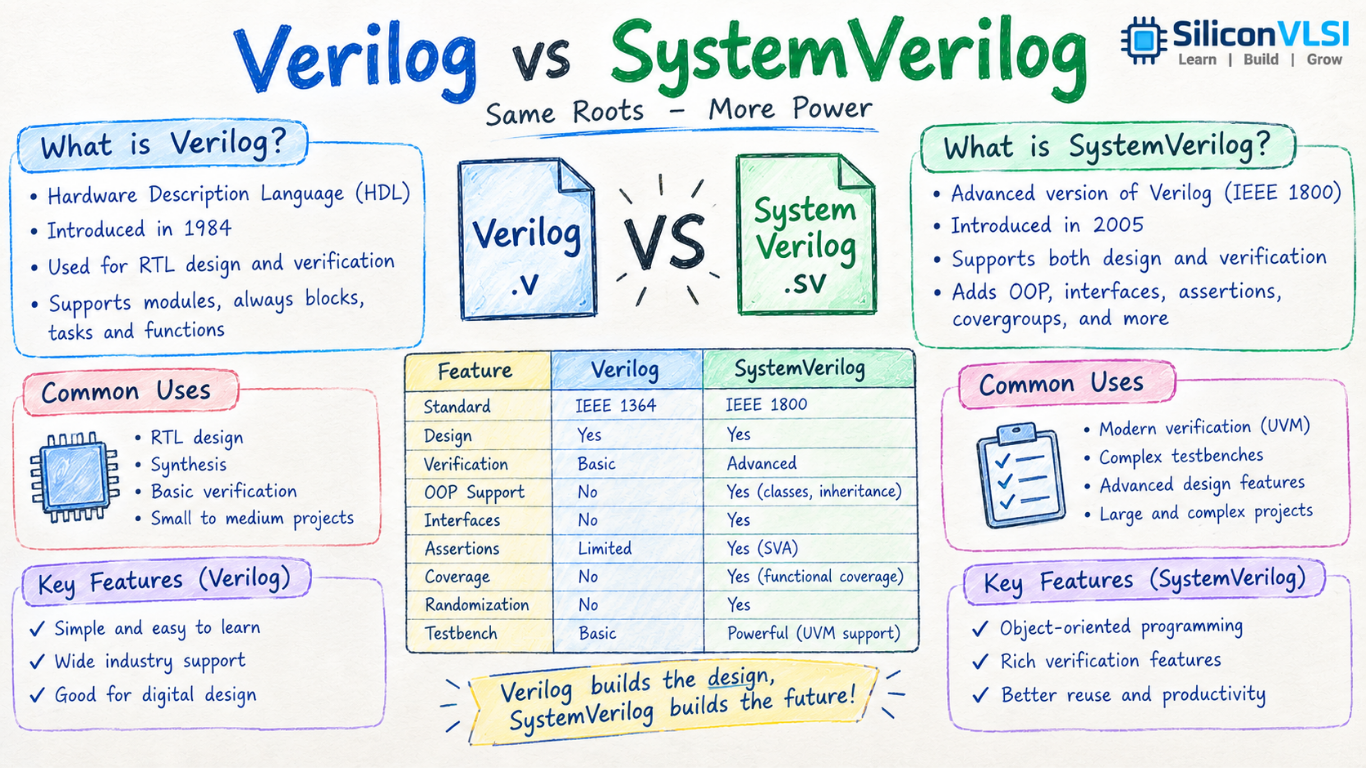
Both languages are widely encountered in VLSI design, but SystemVerilog is increasingly preferred for modern design and verification projects because it provides more powerful constructs and better support for complex designs.
What Is Verilog?
Verilog is a hardware description language (HDL) used to describe and model digital hardware.
It can be used to create RTL descriptions of:
- Combinational logic
- Sequential logic
- Registers
- Counters
- Multiplexers
- Finite-state machines
- Digital systems
Verilog provides the fundamental constructs required to describe the behavior and structure of digital circuits.
What Is SystemVerilog?
SystemVerilog is an extension of Verilog that adds many features for both RTL design and hardware verification.
It provides features such as:
- Interfaces
- Assertions
- Enumerated types
- Structures
- Dynamic arrays
- Classes
- Constrained-randomization
- Functional coverage
- Enhanced data types
- Improved procedural constructs
SystemVerilog therefore provides a much richer environment for developing and verifying complex digital systems.
Verilog vs SystemVerilog: Key Differences
| Aspect | SystemVerilog | Verilog |
|---|---|---|
| Language | Extension of Verilog | Original HDL used for digital design |
| RTL Design | Supports RTL design with additional constructs | Supports RTL design using core HDL constructs |
| Verification | Strong built-in verification features | More limited built-in verification features |
| Assertions | Supports SystemVerilog Assertions (SVA) | No native SVA support |
| Interfaces | Provides interface constructs |
Uses conventional module ports |
| Data Types | Provides many advanced data types | More basic data types |
| Arrays | Supports dynamic, associative, and other advanced arrays | Primarily static arrays |
| Structures | Supports struct and union |
No equivalent modern constructs |
| Enumerations | Supports enum |
No native enumeration type |
| Object-Oriented Programming | Supports classes and object-oriented features | Does not support classes |
| Testbench Development | Well suited for advanced testbenches | Usually requires simpler or external approaches |
| Learning Curve | More features to learn | Generally simpler for beginners |
| Industry Usage | Widely used for modern RTL and verification | Still widely used, especially in existing and legacy designs |
1. Language Features
SystemVerilog extends Verilog rather than replacing its fundamental concepts.
For example, SystemVerilog provides enhanced constructs such as:
logicalways_combalways_ffalways_latchenumstructinterface
These features can make RTL code easier to organize and can communicate design intent more clearly.
Verilog uses traditional constructs such as:
wireregalwaysassignmoduleendmodule
2. RTL Design Capabilities
Both Verilog and SystemVerilog can be used for RTL design.
For example, a simple combinational assignment can be written in SystemVerilog as:
assign y = a & b;
SystemVerilog also provides specialized procedural blocks. For example:
always_comb
is intended for combinational logic, while:
always_ff
is intended for flip-flop-based sequential logic.
These constructs can make the designer’s intent clearer and allow tools to perform additional checks.
3. Verification Capabilities
One of the biggest advantages of SystemVerilog is its support for hardware verification.
SystemVerilog includes features such as:
- Assertions
- Constrained-random stimulus
- Functional coverage
- Classes
- Interfaces
- Advanced data structures
These features are particularly useful when developing sophisticated verification environments.
Verilog can certainly be used to write testbenches, but it does not provide the same built-in verification capabilities.
4. Interfaces
SystemVerilog introduces the interface construct.
An interface can group related signals into a single communication structure between modules.
This can make large designs easier to maintain because a group of signals can be defined and passed around as a common interface rather than repeatedly declaring individual signals.
Traditional Verilog primarily relies on module ports for communication between blocks.
5. Advanced Data Types
SystemVerilog provides many data types that are useful for both design and verification.
Examples include:
logicbitenumstructunion
It also provides advanced array types, including:
- Dynamic arrays
- Associative arrays
- Queues
These features are especially useful in verification environments where large amounts of test data may need to be stored and manipulated.
6. Testbench Development
SystemVerilog is particularly powerful for developing modern verification environments.
Its object-oriented programming capabilities allow verification engineers to create reusable classes and components.
SystemVerilog is also commonly used with UVM (Universal Verification Methodology) for developing structured and reusable verification environments.
Verilog can be used for basic testbenches, but complex verification generally benefits from the additional capabilities provided by SystemVerilog.
7. Learning Curve and Industry Usage
Verilog has fewer language features, so it can be a good starting point for someone learning HDL and RTL concepts.
SystemVerilog has a larger feature set, which means there is more to learn. However, once the basic Verilog concepts are understood, transitioning to SystemVerilog is relatively natural because SystemVerilog builds on Verilog.
For modern RTL and verification work, SystemVerilog is widely used, while Verilog remains important because a large amount of existing RTL and IP is written in Verilog.
Verilog vs SystemVerilog: Which One Should You Learn?
If you are completely new to HDL, learning basic Verilog concepts first can help you understand:
- Modules
- Ports
- Wires
- Registers
- Combinational logic
- Sequential logic
- Blocking and non-blocking assignments
- RTL modeling
After learning these fundamentals, moving to SystemVerilog is a good next step.
For someone preparing for a modern VLSI RTL design or verification career, learning SystemVerilog is highly valuable because of its broader feature set.
A practical learning path is:
Digital Logic → Verilog Fundamentals → RTL Design → SystemVerilog → Verification/UVM
Verilog vs SystemVerilog: Simple Example
Consider an RTL block with a clock and reset.
Traditional Verilog commonly uses:
always @(posedge clk)
SystemVerilog can use:
always_ff @(posedge clk)
The SystemVerilog version communicates that the block is intended to represent flip-flop-based sequential logic.
Similarly, SystemVerilog’s:
always_comb
can be used to describe combinational logic.
These constructs do not fundamentally change the hardware being described; they provide clearer language constructs and additional tool checking.
Common Misconceptions
SystemVerilog completely replaced Verilog
Not exactly.
SystemVerilog extends Verilog, and existing Verilog designs remain widely used. Many modern projects also use a mixture of Verilog and SystemVerilog source files.
Verilog cannot be used for verification
Verilog can absolutely be used to create testbenches. The difference is that SystemVerilog provides many more native features specifically useful for advanced verification.
SystemVerilog is only for verification
No. SystemVerilog is used for both RTL design and verification.
SystemVerilog always produces faster hardware
Not necessarily.
HDLs describe hardware. The resulting performance depends on the RTL implementation, synthesis tool, technology library, constraints, and physical implementation. A SystemVerilog description does not automatically make the resulting circuit faster.
Frequently Asked Questions
Is SystemVerilog better than Verilog?
For modern RTL design and verification, SystemVerilog generally provides a richer feature set. However, Verilog remains useful for learning fundamentals and working with existing designs.
Should I learn Verilog before SystemVerilog?
Learning Verilog fundamentals first can be helpful, but you do not need to master every older Verilog feature before learning SystemVerilog.
Is SystemVerilog used for RTL design?
Yes. SystemVerilog is widely used for RTL design as well as hardware verification.
Is Verilog still used?
Yes. Many existing IP blocks, designs, educational materials, and legacy projects still use Verilog.
What is the main advantage of SystemVerilog?
Its major advantage is that it extends Verilog with powerful constructs for RTL design, verification, assertions, data structures, interfaces, and reusable testbench development.
Which is easier to learn?
Verilog is generally easier for beginners because it has fewer language features. SystemVerilog has a larger feature set and therefore requires more learning.
Conclusion
The main difference between Verilog and SystemVerilog is that SystemVerilog extends Verilog with additional language features for modern RTL design and hardware verification.
Verilog remains an important HDL for understanding digital hardware and working with existing RTL. SystemVerilog adds powerful capabilities such as assertions, interfaces, advanced data types, object-oriented programming, constrained randomization, and functional coverage.
For a beginner, starting with Verilog fundamentals and then moving to SystemVerilog provides a strong foundation for an RTL design or VLSI verification career.