

What Are HVT, SVT (RVT), and LVT Cells in VLSI?
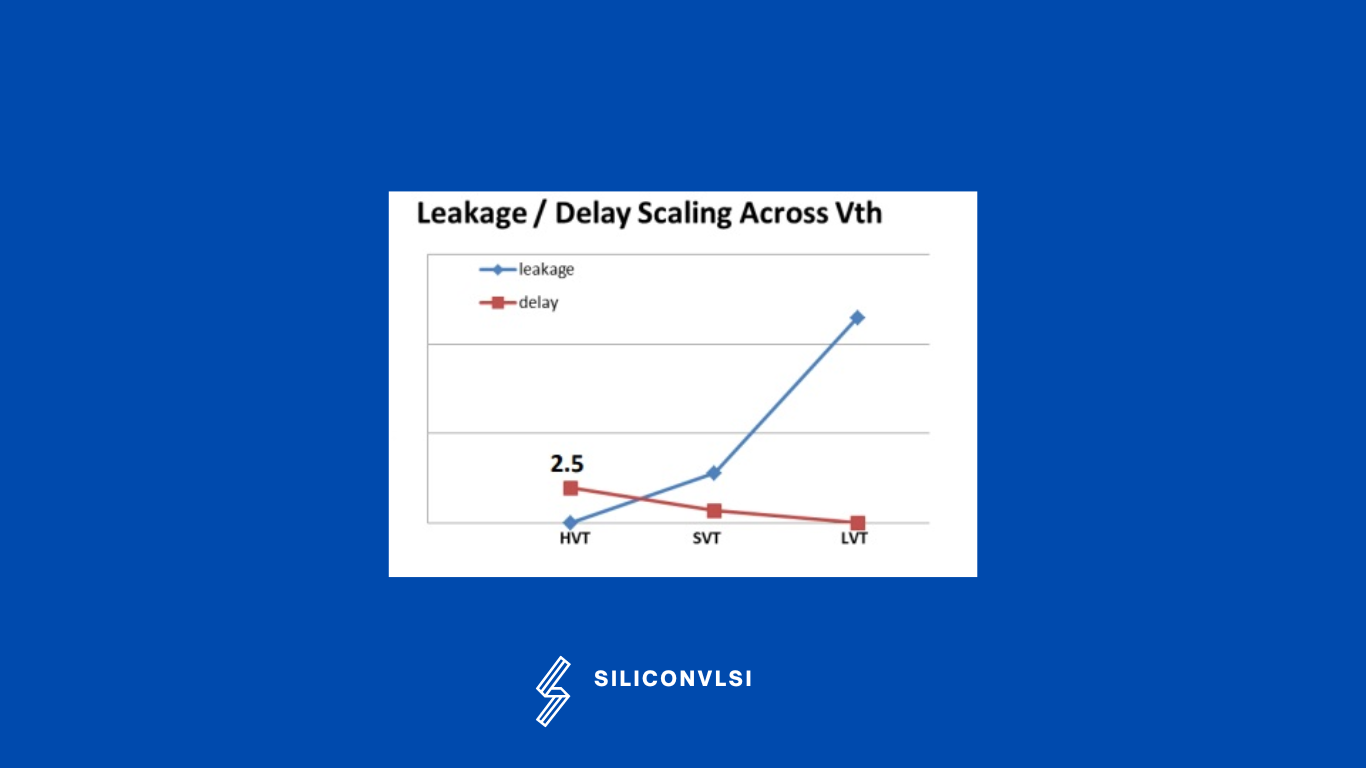
In a VLSI design, not all standard cells are designed to have the same threshold voltage. Libraries commonly provide different threshold-voltage (Vt) options, such as Low-Vt (LVT), Standard-Vt (SVT/RVT), and High-Vt (HVT) cells.
The choice of Vt has a direct impact on an important design trade-off:
Lower Vt → higher speed but higher leakage
Higher Vt → lower leakage but slower operation
Because of this trade-off, physical-design and timing engineers can use different Vt cells at different locations in a chip. For example, LVT cells can be used on timing-critical paths to improve performance, while HVT cells can be used on non-critical paths to reduce leakage power.
What Is Threshold Voltage (Vt)?
The threshold voltage (Vt) of a MOS transistor is the approximate gate-to-source voltage at which a strong inversion channel begins to form between the source and drain.
In simple terms, Vt determines how easily a MOS transistor turns on.
- A low-Vt transistor turns on more easily.
- A high-Vt transistor requires a higher gate voltage to turn on.
The threshold voltage depends on several process and device parameters, including channel doping, gate material/work function, oxide properties, body bias, and device geometry.
For standard-cell libraries, semiconductor manufacturers can provide multiple Vt options so that designers can balance timing, leakage power, and overall power consumption.
What Are LVT, SVT (RVT), and HVT Cells?
The three commonly encountered Vt options are:
LVT — Low Threshold Voltage
LVT stands for Low-Vt (Low Threshold Voltage).
LVT cells have a lower threshold voltage than standard-Vt cells. Since the transistor can turn on more easily, LVT cells generally provide faster switching and lower cell delay.
The disadvantage is increased leakage current when the transistor is supposed to be off.
Therefore, LVT cells are mainly useful in timing-critical paths where additional speed is required.
SVT — Standard Threshold Voltage
SVT stands for Standard-Vt.
It is also commonly called:
- RVT — Regular-Vt
- Nominal-Vt
- Standard-Vt
SVT/RVT cells provide a compromise between performance and leakage.
They are commonly used as the default or general-purpose cells in a design because they provide a reasonable balance between:
- Timing
- Leakage power
- Dynamic power
- Area
HVT — High Threshold Voltage
HVT stands for High-Vt (High Threshold Voltage).
HVT cells have a higher threshold voltage than SVT/RVT and LVT cells.
Because the transistor requires a higher gate voltage to turn on, HVT cells generally have higher delay but significantly lower leakage.
They are therefore useful on paths where timing is not critical and reducing leakage power is more important.
LVT vs SVT vs HVT
The basic relationship can be summarized as follows:
| Parameter | LVT | SVT/RVT | HVT |
|---|---|---|---|
| Threshold voltage | Low | Standard | High |
| Switching speed | Fast | Medium | Slow |
| Cell delay | Low | Medium | High |
| Leakage current | High | Medium | Low |
| Leakage power | High | Medium | Low |
| Typical usage | Timing-critical paths | General-purpose paths | Non-critical paths |
In terms of threshold voltage:
LVT < SVT/RVT < HVT
In terms of cell delay:
LVT < SVT/RVT < HVT
In terms of leakage:
LVT > SVT/RVT > HVT
These relationships are the key reason why multiple Vt libraries are useful in modern VLSI designs.
Why Does Lower Vt Make a Cell Faster?
A lower threshold voltage means the transistor can start conducting at a lower gate voltage.
For a simplified MOSFET model, the drain current in the strong-inversion region depends on the overdrive voltage:
VOV = VGS − VT
When Vt is reduced while VGS remains the same, the overdrive voltage increases.
This allows the transistor to provide more drive current, which can help charge or discharge the load capacitance faster.
As a result:
Lower Vt → higher drive capability → faster switching → lower cell delay
This is why LVT cells are attractive for timing-critical paths.
Why Do LVT Cells Have Higher Leakage?
The main disadvantage of reducing the threshold voltage is increased off-state leakage, particularly subthreshold leakage.
Even when a MOS transistor is intended to be OFF, a small current can flow between the source and drain.
This current becomes strongly dependent on threshold voltage.
A simplified relationship is:
Lower Vt → exponentially higher subthreshold leakage
Therefore, although LVT cells can improve timing, they can also increase the static or leakage power of the chip.
This is one of the most important trade-offs when selecting between LVT, SVT/RVT, and HVT cells.
Why Do HVT Cells Have Lower Leakage?
HVT cells have a higher threshold voltage.
When the transistor is OFF, the higher Vt makes it more difficult for carriers to form a conducting channel. Consequently, the off-state leakage current is reduced.
Therefore:
Higher Vt → lower subthreshold leakage → lower leakage power
The trade-off is that the transistor also turns on more slowly, which increases cell delay.
What Is the Difference Between LVT and HVT Cells?
The primary difference between LVT and HVT cells is their threshold voltage.
An LVT cell has a lower threshold voltage, allowing its transistors to switch faster. However, it also has higher leakage.
An HVT cell has a higher threshold voltage, resulting in lower leakage but greater delay.
The choice therefore depends on the timing requirements of the circuit.
For example:
- A path failing setup timing may benefit from LVT cells.
- A path with plenty of timing margin may use HVT cells to reduce leakage.
- SVT/RVT cells can be used when neither extreme is necessary.
Why Are Multiple Vt Cells Used in VLSI?
Using only LVT cells would provide good performance, but the design could suffer from excessive leakage power.
Similarly, using only HVT cells would reduce leakage but could make the design too slow.
Modern VLSI designs therefore use multi-Vt optimization.
Different cells can be selected according to the timing requirements of individual paths.
For example:
Timing-critical path → LVT
Normal path → SVT/RVT
Timing-relaxed path → HVT
This allows designers to achieve the required performance without unnecessarily increasing leakage across the entire chip.
Multi-Vt Optimization in Physical Design
During physical design, timing analysis identifies paths that are critical for setup or other timing constraints.
If a path is too slow, cells on that path can potentially be changed to a faster Vt option.
For example:
HVT → SVT → LVT
Each step can improve timing, although it may increase leakage power.
On the other hand, if a path has sufficient timing slack, a designer can replace a lower-Vt cell with a higher-Vt cell:
LVT → SVT → HVT
This can reduce leakage while preserving the required timing.
Therefore, Vt swapping is an important optimization technique in low-power physical design.
LVT, SVT, and HVT: A Simple Example
Suppose a design contains three paths:
Path 1 — Timing Critical
This path has very little timing slack.
Using an HVT cell may make the path too slow, so an LVT cell could be selected to improve timing.
Choice: LVT
Path 2 — Normal Timing
This path meets timing comfortably with a standard cell.
There may be no need to use an LVT cell and pay the additional leakage penalty.
Choice: SVT/RVT
Path 3 — Timing Relaxed
This path has significant positive slack.
A slower HVT cell can be used without violating timing, while reducing leakage.
Choice: HVT
This illustrates how different Vt cells can coexist in the same design.
Does LVT Always Mean a Thinner Gate Oxide?
Not necessarily.
It is incorrect to assume that every LVT cell has a thinner gate oxide than an HVT cell.
The actual method used to create different threshold-voltage options depends on the semiconductor process and library technology. Threshold voltage can be engineered using techniques such as channel engineering, work-function engineering, doping adjustments, and other process/device modifications.
Therefore, the safer general statement is:
LVT cells are engineered to have a lower threshold voltage, while HVT cells are engineered to have a higher threshold voltage.
The exact process used to achieve those Vt values depends on the technology node and foundry process.
Advantages and Disadvantages of LVT Cells
Advantages
- Faster switching
- Lower cell delay
- Useful for timing-critical paths
- Can help fix setup timing violations
- Higher drive capability for a given operating condition
Disadvantages
- Higher leakage current
- Higher leakage power
- Can increase total power consumption
- Excessive use can make power optimization difficult
Advantages and Disadvantages of HVT Cells
Advantages
- Lower leakage current
- Lower leakage power
- Useful for non-critical paths
- Helps reduce standby power
Disadvantages
- Higher cell delay
- Slower switching
- May cause timing violations if used on critical paths
- Not suitable for every timing-critical path
Advantages and Disadvantages of SVT/RVT Cells
SVT/RVT cells provide a middle ground between LVT and HVT.
Advantages
- Balanced speed and leakage
- Suitable for general-purpose logic
- Often used as the default Vt option
- Provides a good starting point for optimization
Disadvantages
- Not as fast as LVT
- Not as low-leakage as HVT
- May need to be replaced with LVT or HVT during timing/power optimization
What Happens If We Use Only LVT Cells?
Using LVT cells throughout the design may improve performance, but it is usually not an efficient solution.
Because LVT cells have lower threshold voltage, they generally have higher leakage current.
If thousands or millions of cells are implemented using LVT, the total leakage power can become significant.
Therefore, LVT cells should generally be used where their performance advantage is actually needed rather than everywhere in the design.
What Happens If We Use Only HVT Cells?
Using only HVT cells can significantly reduce leakage, but the design may become too slow.
Timing-critical paths may fail because HVT cells have higher delay.
Therefore, HVT cells are best suited for paths that have sufficient timing margin.
LVT vs SVT vs HVT: Which One Should You Use?
There is no single Vt option that is best for every situation.
The choice depends on the design requirements.
Use LVT when:
- Timing is critical.
- The path has insufficient slack.
- Additional speed is required.
- The design can tolerate additional leakage.
Use SVT/RVT when:
- A balanced speed/leakage trade-off is required.
- The path does not require aggressive optimization.
- Standard library performance is sufficient.
Use HVT when:
- Timing is relaxed.
- The path has sufficient positive slack.
- Leakage reduction is important.
- Low-power operation is a priority.
Key Takeaway
LVT, SVT/RVT, and HVT are different threshold-voltage options provided in standard-cell libraries to help designers balance performance and power.
The fundamental trade-off is:
LVT → Faster + Higher Leakage
SVT/RVT → Balanced Speed + Leakage
HVT → Slower + Lower Leakage
In practical VLSI design, these cells are often used together. LVT cells can be reserved for timing-critical paths, SVT/RVT cells can handle general logic, and HVT cells can be used wherever timing allows additional delay.
This multi-Vt approach helps designers meet timing requirements while controlling leakage power and overall chip power consumption.