

Comparison Between SRAM and DRAM
Why Is SRAM Faster Than DRAM? 7 Key Differences Explained
SRAM (Static Random Access Memory) is generally faster than DRAM (Dynamic Random Access Memory) because SRAM stores each bit using a bistable circuit, typically a 6-transistor (6T) memory cell, and does not require periodic refresh while retaining valid data as long as power is supplied.
DRAM, in contrast, stores data as electrical charge on a capacitor. Because this charge gradually leaks away, DRAM cells must be periodically refreshed.
This difference in storage mechanism, refresh requirement, and memory-cell architecture is the main reason SRAM can provide lower latency and faster access than conventional DRAM.
What Is RAM?
RAM stands for Random Access Memory. It is a type of volatile memory used to temporarily store data and instructions while a system is operating.
Random access means that a memory location can be accessed without having to read all the preceding locations first.
The two major types of semiconductor RAM are:
- SRAM — Static Random Access Memory
- DRAM — Dynamic Random Access Memory
Both are volatile, meaning their stored information is lost when power is removed.
However, they use different methods to store each bit.
Why Is SRAM Faster Than DRAM?
The primary reason is that SRAM does not require periodic refresh operations.
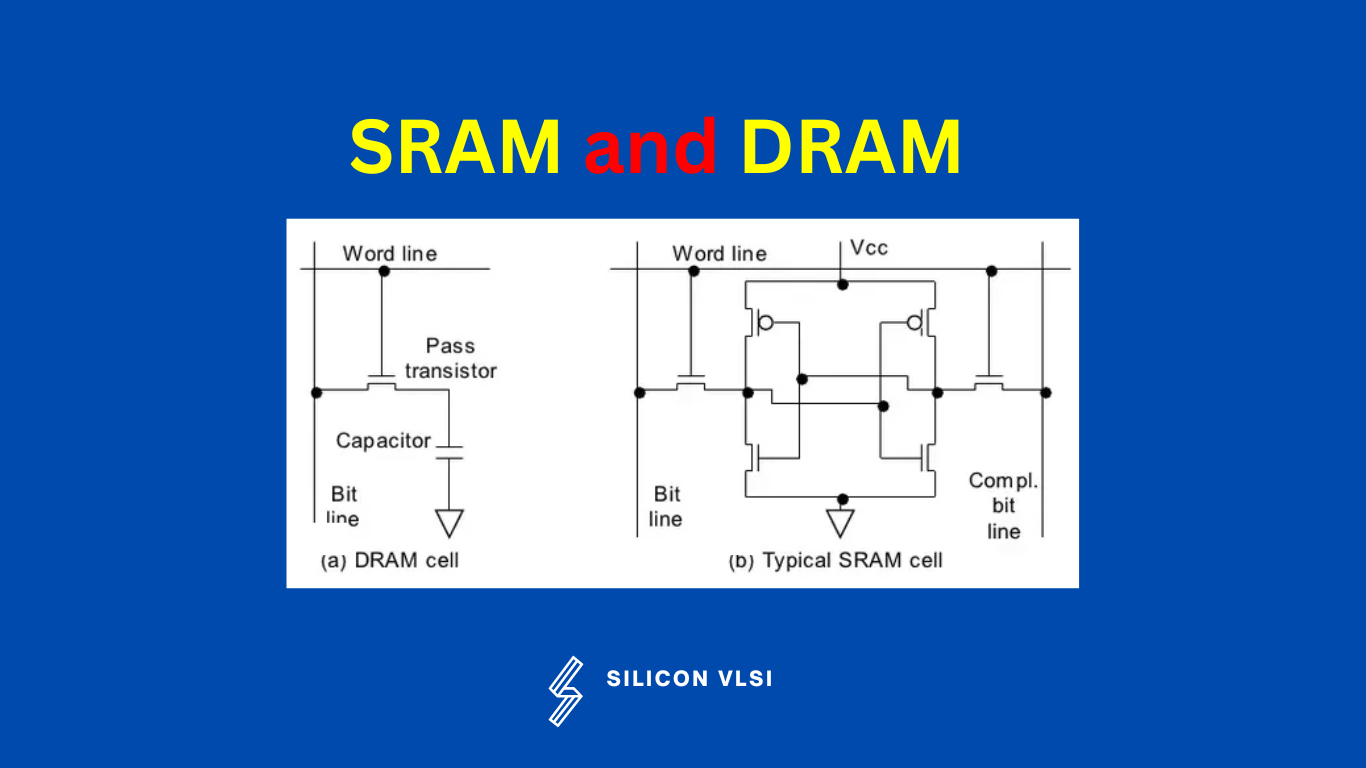
A typical SRAM cell uses a cross-coupled inverter structure that creates two stable states. As long as power is available, the cell can maintain its stored state without periodically rewriting the data.
A conventional DRAM cell uses a transistor and capacitor. The capacitor stores charge representing the data, but the charge gradually leaks away. Therefore, DRAM requires regular refresh operations.
In simplified form:
SRAM → latch-based storage → no periodic refresh → faster access
DRAM → capacitor-based storage → periodic refresh → additional overhead
This does not mean that refresh is the only factor determining memory performance. SRAM also benefits from its cell architecture and the way SRAM arrays are designed and accessed.
How Does an SRAM Cell Store Data?
A conventional SRAM bit cell commonly uses six transistors, known as a 6T SRAM cell.
The core storage element consists of two cross-coupled CMOS inverters.
These inverters create two stable states:
- One state represents logic 0
- The other state represents logic 1
Two additional pairs of access transistors connect the storage nodes to the bit lines during read and write operations.
Because the cell has two stable states, the stored value remains available as long as the power supply is maintained.
This is why the memory is called static RAM.

A conventional DRAM cell typically consists of:
- One access transistor
- One storage capacitor
The capacitor stores electrical charge.
Depending on the charge level, the cell represents a logical 1 or 0.
The problem is that the capacitor cannot hold its charge indefinitely. Leakage mechanisms gradually reduce the stored charge.
Therefore, DRAM periodically performs a refresh operation to restore the stored information.
This refresh requirement adds memory-management overhead that does not exist in the same form for a conventional SRAM cell.
| Feature | SRAM | DRAM |
|---|---|---|
| Storage cell | Typically 6 transistors | Typically 1 transistor + 1 capacitor |
| Refresh | Not periodically required while powered | Required |
| Access latency | Generally lower | Generally higher |
| Density | Lower | Higher |
| Cost per bit | Higher | Lower |
| Cell area | Larger | Smaller |
| Typical use | CPU caches and small high-speed memories | Main memory and high-capacity memory |
The exact performance depends on the particular memory technology, process, architecture, interface, and operating conditions.
SRAM Does Not Need Periodic Refresh
The biggest architectural advantage of SRAM is its bistable storage mechanism.
Once a 6T SRAM cell has been written, the cross-coupled inverters continuously reinforce the stored state while power is supplied.
Therefore, SRAM does not need the periodic refresh operation required by conventional DRAM.
This results in:
No periodic refresh → less refresh overhead → potentially lower access latency
However, SRAM still consumes power while operating and can have significant static/leakage power, particularly in scaled technologies.
Why Does DRAM Need Refresh?
The capacitor in a DRAM cell gradually loses its stored charge because of leakage.
If the charge falls below the required sensing margin, the stored bit may no longer be reliably distinguished.
To prevent this, the memory controller and DRAM device periodically perform refresh operations.
A simplified sequence is:
Store charge → charge leaks → refresh → restore charge → repeat
Refresh consumes energy and occupies memory resources, although modern DRAM architectures are specifically designed to manage this overhead efficiently.
SRAM Is Faster, but Why Is It More Expensive?
The answer lies mainly in memory-cell area and density.
A conventional SRAM cell typically requires six transistors, whereas a conventional DRAM cell can use only one transistor and one capacitor.
Therefore, SRAM requires considerably more silicon area for the same number of stored bits.
For example, storing one million bits requires a large number of transistors in an SRAM array.
DRAM can achieve much higher bit density because its individual cells are physically smaller.
As a result:
SRAM → larger cell → lower density → higher cost per bit
DRAM → smaller cell → higher density → lower cost per bit
This is why large-capacity system memory is generally implemented using DRAM rather than SRAM.
SRAM and DRAM Power Consumption
It is too broad to say that SRAM always consumes less power than DRAM.
Their power characteristics are different.
SRAM Power
SRAM power can include:
- Leakage power
- Read power
- Write power
- Bit-line charging and discharging
- Peripheral circuit power
Because SRAM does not require periodic refresh, it avoids refresh-related energy consumption.
However, a large SRAM array contains many transistors, which can result in substantial leakage and dynamic power.
DRAM Power
DRAM power includes:
- Read/write activity
- Bit-line and word-line switching
- Sense-amplifier operation
- Refresh operations
- Peripheral circuitry
- Leakage
Refresh is an important component of DRAM power consumption, especially because it must occur even when the processor is not actively accessing every stored bit.
Therefore, the statement “SRAM always consumes less power than DRAM” should be avoided. Power depends on memory size, access pattern, technology, operating state, and architecture.
Speed Comparison Between SRAM and DRAM
SRAM generally provides lower latency than conventional DRAM.
The reason is not simply that SRAM “has no refresh.” The storage cell, sensing architecture, array organization, interface, and memory controller also influence the final access time.
Therefore, instead of using fixed values such as 10 ns for SRAM and 60 ns for DRAM, it is better to describe the relationship qualitatively unless comparing specific memory technologies.
Typical relationship:
SRAM → lower latency
DRAM → higher latency but much higher density
This distinction is especially important when discussing modern semiconductor memory because actual specifications vary significantly between memory generations and implementations.
Capacity and Density
One of the biggest advantages of DRAM is its high memory density.
A conventional DRAM cell uses approximately one transistor and one capacitor per bit, while a typical 6T SRAM cell requires six transistors.
Therefore, SRAM occupies significantly more area per stored bit.
This creates a fundamental trade-off:
SRAM → speed and low latency
DRAM → density and capacity
This is why processors typically contain relatively small amounts of SRAM for cache memory while computers and servers use much larger amounts of DRAM for main memory.
Where Is SRAM Used?
SRAM is commonly used when low latency and high-speed access are more important than achieving the lowest cost per bit.
Typical applications include:
CPU Cache
Processor caches such as L1, L2, and portions of L3 cache commonly use SRAM or SRAM-like memory structures because processors need very fast access to frequently used data and instructions.
Register Files
High-speed register files in processors can use SRAM-derived or related memory-cell structures.
Embedded Memory
Many microcontrollers, SoCs, networking chips, and other ICs contain embedded SRAM.
Buffers
SRAM can also be used for high-speed buffers and temporary data storage inside integrated circuits.
Where Is DRAM Used?
DRAM is preferred when high capacity and low cost per bit are important.
Common applications include:
- Main system memory
- Server memory
- Graphics memory variants
- Mobile device memory
- Large-capacity memory modules
The higher density of DRAM makes it practical to manufacture memory capacities that would be much more expensive using conventional SRAM.
Advantages of SRAM
- Very low access latency compared with conventional DRAM
- No periodic refresh operation for data retention while powered
- Simple direct storage using a bistable cell
- Excellent for high-speed memory applications
- Widely used for processor cache and embedded memory
Disadvantages of SRAM
- Larger cell area
- Lower memory density
- Higher cost per bit
- More transistors required per stored bit
- Large arrays can have significant leakage and dynamic power
Advantages of DRAM
- High memory density
- Lower cost per bit
- Suitable for large-capacity memory
- Smaller conventional memory cell
- Widely used for main system memory
Disadvantages of DRAM
- Requires periodic refresh
- Refresh consumes energy
- Generally higher access latency than SRAM
- More complicated sensing and memory-management requirements
- Stored charge must be reliably detected despite leakage
Why Is SRAM Used for Cache Memory?
Processor cache needs to respond very quickly.
The processor frequently accesses cache data, so reducing memory latency can significantly improve system performance.
SRAM is well suited to this requirement because it offers fast access and does not require the periodic refresh operation associated with conventional DRAM.
The trade-off is that SRAM consumes considerably more silicon area per bit.
Therefore, processors generally use small amounts of very fast SRAM close to the CPU cores rather than using SRAM for the entire main-memory capacity.
Why Is DRAM Used as Main Memory?
Main memory needs to store a large amount of data.
Using SRAM for several gigabytes of memory would require a very large silicon area and would be expensive.
DRAM provides much higher density at a lower cost per bit.
Therefore, computer architectures typically use:
CPU registers → very small and extremely fast
Cache → SRAM-based, fast and relatively small
Main memory → DRAM-based, larger and relatively slower
This hierarchy provides a practical balance between speed, capacity, and cost.
SRAM vs DRAM: A Simple Example
Imagine a processor needs to access a frequently used piece of data.
If the data is available in an SRAM-based cache, the processor can access it with very low latency.
If the required data is not present in the cache, the system may need to access DRAM.
The DRAM access can involve additional operations and significantly higher latency.
This is one reason computer systems use a memory hierarchy rather than relying on a single type of memory.
Common Questions About SRAM and DRAM
Which is faster, SRAM or DRAM?
SRAM is generally faster than conventional DRAM. Its storage architecture provides low-latency access and it does not require periodic refresh operations for retaining data while powered.
Why does SRAM not need refresh?
A conventional SRAM cell stores data using a bistable circuit rather than relying on charge stored on a capacitor. The cross-coupled inverters maintain the state while power is supplied.
Why does DRAM need refresh?
DRAM stores information as charge on a capacitor. Because the charge gradually leaks away, the stored data must be periodically restored.
Why is SRAM more expensive than DRAM?
A conventional SRAM cell typically uses six transistors, while a conventional DRAM cell uses one transistor and one capacitor. SRAM therefore requires substantially more silicon area per bit.
Which has higher density, SRAM or DRAM?
DRAM has much higher density than conventional SRAM because its memory cell requires significantly less area.
Does SRAM consume less power than DRAM?
Not necessarily in every operating condition. SRAM avoids refresh power, but its larger number of transistors can contribute to substantial leakage and switching power. Actual power depends on the memory architecture and workload.
Why is SRAM used in CPU cache?
SRAM provides the low latency needed for frequently accessed processor data and instructions. Its higher area and cost make it unsuitable for replacing large amounts of main memory.
Why is DRAM used for main memory?
DRAM provides high density and relatively low cost per bit, making it suitable for large-capacity system memory.
Key Takeaways
- SRAM is generally faster than conventional DRAM.
- A typical SRAM cell uses six transistors and stores data using a bistable circuit.
- A conventional DRAM cell uses one transistor and one capacitor.
- DRAM requires periodic refresh because its stored capacitor charge gradually leaks away.
- SRAM has lower latency but requires significantly more silicon area per bit.
- DRAM provides much higher density and lower cost per bit.
- SRAM is commonly used for CPU caches and embedded high-speed memory.
- DRAM is commonly used for large-capacity main memory.
- SRAM does not universally consume less power; power depends on the architecture and operating conditions.
- The fundamental SRAM-versus-DRAM trade-off is speed and latency versus density and cost.
SRAM and DRAM