

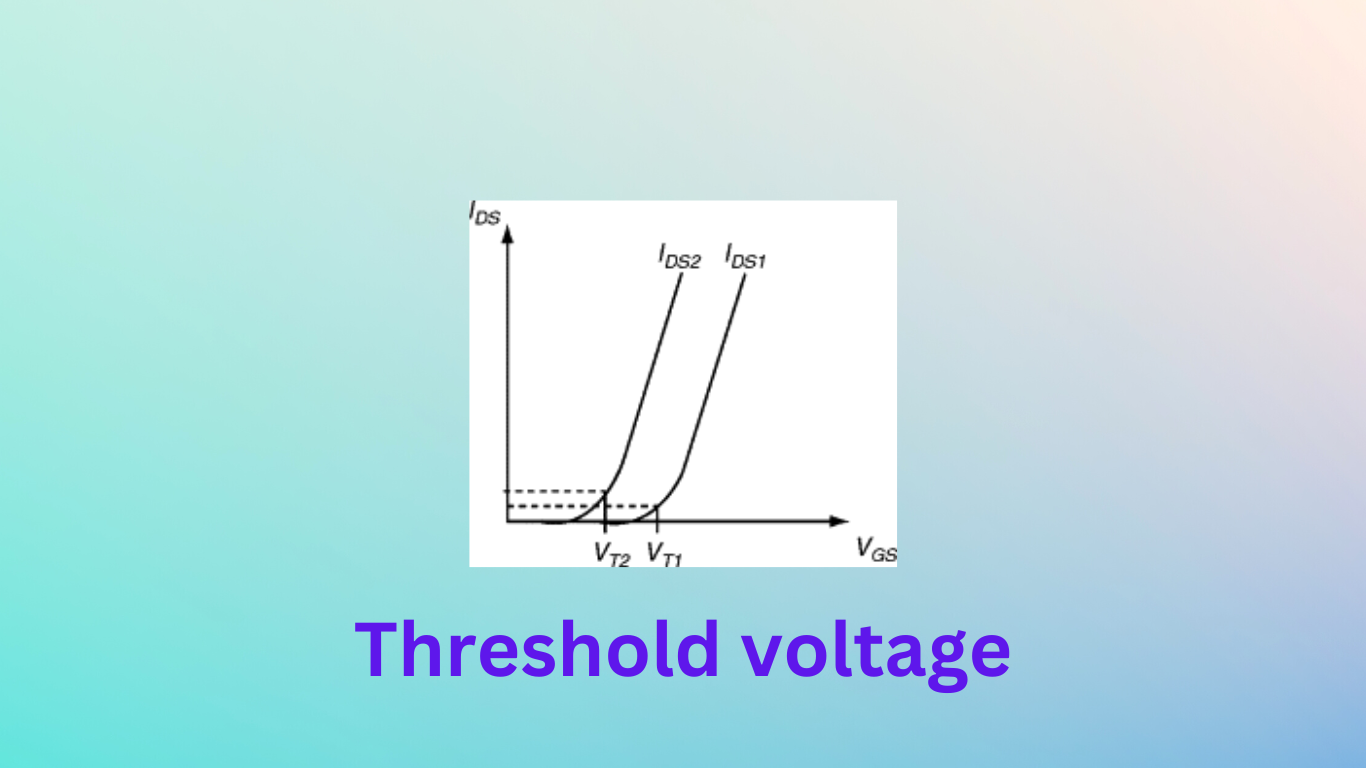
What is the threshold voltage?
What Is Threshold Voltage? A Key Parameter in MOSFET Operation
Threshold voltage (Vth) is one of the most important parameters that determines how a MOSFET turns on and off. It represents the approximate gate-to-source voltage at which a strong inversion channel begins to form between the source and drain, allowing the transistor to conduct significant current.
In CMOS design, threshold voltage directly affects switching speed, leakage current, power consumption, and circuit reliability. Understanding Vth is therefore essential for both transistor-level and VLSI design.
What Is Threshold Voltage?
The threshold voltage, commonly written as Vth, is the gate-to-source voltage at which a MOS transistor begins to form a conducting channel between its source and drain.
For an NMOS transistor, increasing the gate voltage above its threshold voltage creates an electron-rich inversion layer beneath the gate oxide. This inversion layer connects the source and drain, allowing current to flow.
A simplified condition for an NMOS is:
VGS > Vth → transistor is strongly ON
VGS < Vth → transistor is weakly ON or OFF
The exact behavior is more gradual than this simple ON/OFF model, particularly around the threshold region.
Threshold Voltage in CMOS
In CMOS circuits, both NMOS and PMOS transistors have threshold voltages.
For an NMOS:
- VGS must become sufficiently positive to turn the device on.
- The threshold voltage is normally represented as a positive value.
For a PMOS:
- The gate must be sufficiently negative relative to the source.
- Its threshold voltage is normally represented as a negative value, although some discussions use its magnitude, |Vth|.
The threshold voltage is an important design parameter because it influences the point at which a transistor changes from a low-conduction state to a high-conduction state.
Why Is Threshold Voltage Important?
Threshold voltage affects several important MOSFET characteristics.
1. Switching Speed
A lower threshold voltage generally allows a transistor to begin conducting at a lower gate voltage.
This can help improve transistor switching speed, which is particularly useful in timing-critical paths in digital circuits.
However, lowering Vth also increases the possibility of unwanted current when the transistor is supposed to be OFF.
2. Leakage Current
Threshold voltage has a strong relationship with subthreshold leakage.
A transistor with a lower Vth generally has higher leakage when it is intended to be OFF. Conversely, a higher-Vth device can provide better leakage control but may switch more slowly.
This creates an important trade-off:
Low Vth → higher speed, higher leakage
High Vth → lower leakage, potentially lower speed
This is one reason modern VLSI designs often use different threshold-voltage options.
3. Power Consumption
Leakage current contributes to the static power consumption of CMOS circuits.
Therefore, selecting an appropriate threshold voltage is important when designing low-power systems.
4. Noise Margin and Circuit Reliability
Threshold voltage also influences the switching behavior and voltage margins of digital circuits.
Process, voltage, and temperature variations can change the effective threshold voltage, so designers must ensure that circuits continue to operate correctly across the expected PVT conditions.
What Determines Threshold Voltage?
The threshold voltage is not determined by a single parameter. It depends on several physical and electrical properties of the MOS structure.
Important factors include:
- Substrate or body doping
- Gate material and work function
- Gate-oxide thickness
- Fixed and interface charges
- Source/body and drain/body conditions
- Body voltage
- Device dimensions and short-channel effects
- Manufacturing process variations
A simplified threshold-voltage relationship can be written as:
Vth = VFB + 2φF + γ√(2φF + VSB)
for a conventional NMOS formulation, where the terms represent the flat-band voltage, surface-potential contribution, body-effect contribution, and related device parameters.
The exact equation and parameters depend on the MOSFET structure and process technology.
Effect of Doping on Threshold Voltage
The doping concentration in the semiconductor region beneath the gate plays an important role in determining Vth.
By changing the doping profile, semiconductor manufacturers can engineer different threshold-voltage characteristics.
However, it is important to note that threshold voltage is not controlled simply by source/drain doping. In practical CMOS processes, threshold engineering involves factors such as channel/body doping, gate work function, oxide/interface properties, and process-specific implants.
Effect of Gate-Oxide Thickness
The thickness and electrical properties of the gate oxide also influence threshold voltage.
A thinner oxide increases the gate’s electrostatic control over the channel because the gate capacitance per unit area increases.
Modern technologies use advanced gate dielectric structures, so the relationship between physical dielectric thickness and Vth is more complex than in a basic textbook MOS model.
Effect of Gate Material
The gate material and its work function influence the voltage required to create the inversion layer.
Traditional MOS technologies commonly used polysilicon gates, while many modern CMOS technologies use metal-gate structures.
Changing the gate work function allows manufacturers to adjust transistor threshold voltage.
Body Effect and Threshold Voltage
The threshold voltage can change when the voltage between the source and body changes. This phenomenon is called the body effect or substrate-bias effect.
For an NMOS, a common expression is:
Vth = Vth0 + γ(√(2φF + VSB) − √(2φF))
where:
- Vth0 = threshold voltage when source and body are at the same potential
- γ = body-effect coefficient
- φF = Fermi potential
- VSB = source-to-body voltage
As VSB increases, the threshold voltage of a conventional NMOS generally increases.
This means that the transistor requires a higher gate voltage to achieve the same level of conduction.
Low-Vth, Standard-Vth and High-Vth Devices
Modern VLSI technologies often provide multiple threshold-voltage options.
Low-Vth (LVT)
LVT devices have a relatively low threshold voltage.
Advantages:
- Faster switching
- Suitable for timing-critical paths
- Higher drive capability at a given supply voltage
Disadvantage:
- Higher leakage current
Standard-Vth (SVT)
SVT, sometimes called regular-Vth or nominal-Vth depending on the technology, provides a compromise between speed and leakage.
It is commonly used where neither extreme performance nor minimum leakage is the primary requirement.
High-Vth (HVT)
HVT devices have a relatively high threshold voltage.
Advantages:
- Lower leakage
- Useful for non-critical paths
- Can help reduce static power
Disadvantage:
- Generally slower than an equivalent low-Vth device
The actual threshold-voltage values for LVT, SVT, and HVT are technology-dependent and should be obtained from the relevant PDK or standard-cell library rather than assuming universal numerical values.
Threshold Voltage and MOSFET Operating Regions
Vth is also important when determining the operating region of a MOSFET.
For an NMOS, when:
VGS < Vth
the device is below strong inversion.
When:
VGS > Vth
an inversion channel is formed and the transistor can conduct significant current.
For the simplified long-channel model, the transistor enters saturation when:
VDS ≥ VGS − Vth
This relationship is fundamental to understanding MOSFET current equations and analog circuit operation.
Threshold Voltage in Digital VLSI
In digital VLSI, threshold voltage directly influences the trade-off between performance and leakage power.
Consider two otherwise similar transistors:
- A low-Vth transistor can switch faster but tends to leak more.
- A high-Vth transistor can reduce leakage but may introduce additional delay.
Therefore, physical-design and library-selection techniques can use different threshold-voltage cells depending on timing and power requirements.
For example:
Critical timing path → LVT may be preferred
Non-critical path → HVT may be preferred
General-purpose path → SVT may provide a balanced solution
The exact choice depends on the technology, timing constraints, power targets, and library characterization.
Threshold Voltage and PVT Variation
Threshold voltage is affected by process, voltage, and temperature (PVT) variations.
Process Variation
Manufacturing variations can change parameters such as:
- Doping concentration
- Oxide characteristics
- Gate dimensions
- Work function
- Interface properties
These variations can cause the actual Vth of fabricated transistors to differ from its nominal value.
Voltage Variation
Supply and body voltages can influence transistor behavior and, depending on the circuit and device structure, the effective operating conditions around the threshold.
Temperature Variation
Temperature changes can affect carrier mobility, leakage, and threshold voltage. Therefore, semiconductor circuits must be analyzed across the required temperature range.
Threshold Voltage vs. Turn-On Voltage
These two terms are sometimes used interchangeably in simple explanations, but they are not exactly the same.
Threshold voltage is a defined device parameter associated with the onset of strong inversion or a specified current criterion.
A MOSFET does not suddenly change from completely OFF to completely ON at exactly Vth.
Instead, current increases continuously as the gate voltage changes.
Therefore, saying “Vth is the voltage at which the MOSFET becomes fully ON” is an oversimplification.
A better definition is:
Threshold voltage is the gate-to-source voltage associated with the formation of a strong inversion channel and the onset of significant conduction, according to a defined device criterion.
Why Is Vth Important in Analog Design?
Threshold voltage is also important in analog circuits.
It affects:
- Drain current
- Transconductance
- Operating point
- Input/output voltage range
- Gain
- Headroom
- Bias conditions
For example, in a simplified saturation-region model:
ID ≈ ½ μnCox(W/L)(VGS − Vth)²
This shows that the difference between VGS and Vth, often called the overdrive voltage, strongly influences the drain current.
Common Questions About Threshold Voltage
What happens when VGS is below Vth?
The MOSFET is not in strong inversion and the drain current is greatly reduced. However, a small subthreshold current can still exist.
Does lower Vth always mean a better MOSFET?
No.
Lower Vth can improve speed but generally increases leakage. The appropriate value depends on the design objective.
Why is Vth different for NMOS and PMOS?
NMOS and PMOS use different carrier types and device structures, and their body, gate, and work-function conditions result in different threshold-voltage polarities and magnitudes.
Can threshold voltage change after fabrication?
The physical device’s threshold characteristics are set primarily by the fabrication process, but the effective operating threshold behavior can be influenced by body bias, temperature, bias conditions, aging, and other effects.
What is the relationship between Vth and leakage current?
In general, reducing Vth increases subthreshold leakage, while increasing Vth tends to reduce it. This is why LVT and HVT devices are used for different VLSI design requirements.
Key Takeaways
- Threshold voltage (Vth) is a fundamental MOSFET parameter.
- It determines the gate voltage associated with strong inversion and significant channel conduction.
- Vth affects speed, leakage, power, and circuit behavior.
- Channel/body properties, gate work function, oxide characteristics, and other process parameters influence Vth.
- LVT devices generally provide higher speed at the cost of higher leakage.
- HVT devices generally reduce leakage but can increase delay.
- SVT provides a compromise between speed and leakage.
- Body bias can change the threshold voltage through the body effect.
- Vth must be considered across PVT variations in practical VLSI design.