
CMOS Process Integration: FEOL and BEOL Explained
CMOS process integration is the coordinated sequence of semiconductor manufacturing steps used to build CMOS transistors and then connect them into a functional integrated circuit.
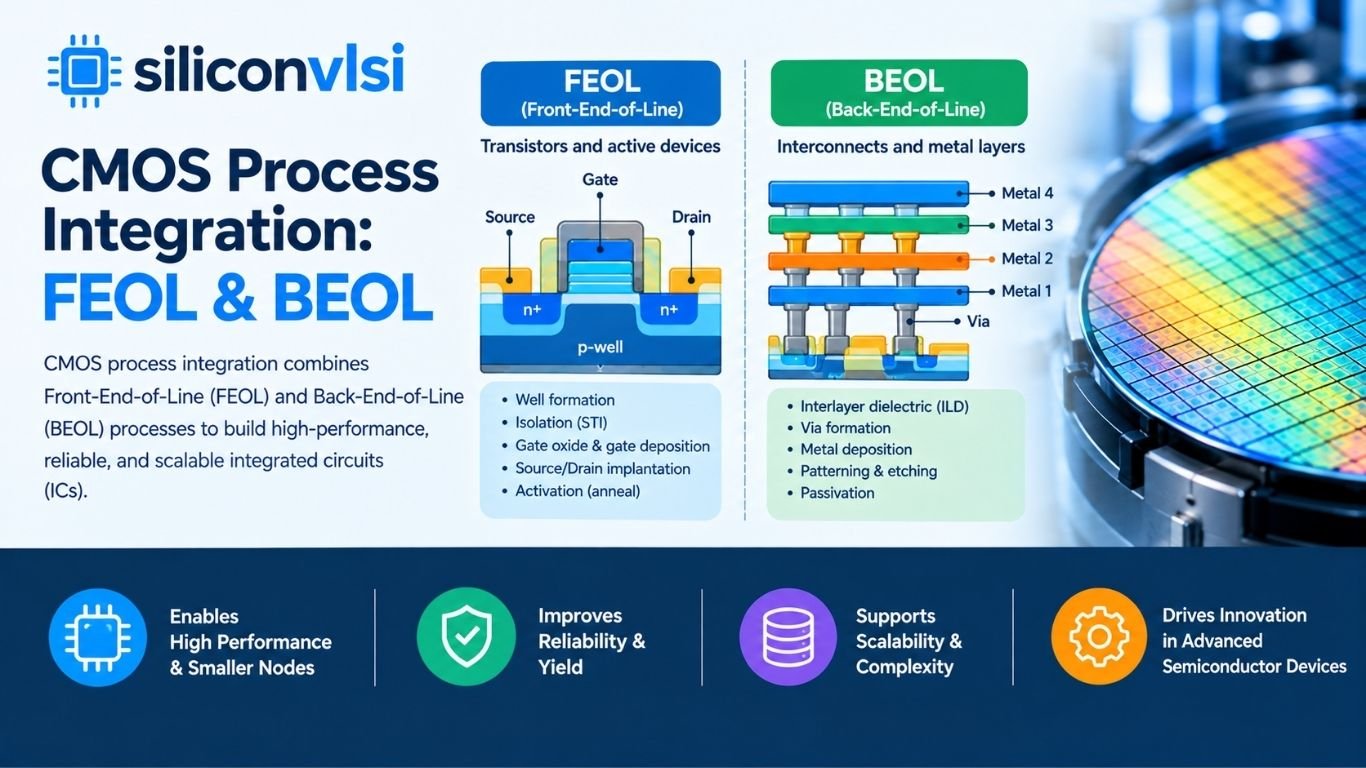
The CMOS fabrication process is commonly divided into two major sections:
- FEOL (Front End of Line): focuses mainly on forming the semiconductor devices and their structures.
- BEOL (Back End of Line): focuses mainly on forming contacts and the interconnect structure that electrically connects those devices.
The exact process sequence varies with the technology node and process platform, but the FEOL/BEOL division provides a useful way to understand CMOS manufacturing[1].
What Is FEOL in CMOS?
FEOL (Front End of Line) includes the fabrication steps used to form the transistor structures in and on the silicon wafer.
The main FEOL steps in the source material are:
- Wafer preparation
- Well formation
- Isolation
- Threshold-voltage adjustment
- Gate formation
- LDD extension implantation
- Source/drain implantation
1. Wafer Preparation
CMOS fabrication starts with a semiconductor wafer. A conventional CMOS process may use a p-type substrate, although the exact starting wafer and substrate configuration depend on the process technology.
The wafer undergoes cleaning and preparation steps before device fabrication begins.
The quality of the starting wafer is important because defects and contamination can affect subsequent process steps and the performance of the final devices.
2. Well Formation
Well formation creates the semiconductor regions in which NMOS and PMOS transistors are formed.
Common well structures include:
Twin-Well Process
The twin-well process forms separate wells for NMOS and PMOS devices. This provides greater flexibility for controlling the electrical characteristics of the two transistor types.
Triple-Well Process
A triple-well process adds an additional well structure that can provide greater isolation and substrate-bias flexibility for selected circuits.
The exact well structure and implantation sequence are technology-dependent.
3. Isolation Process
Isolation prevents unwanted electrical interaction between neighboring devices.
Two important isolation approaches are:
Shallow Trench Isolation (STI)
In STI, shallow trenches are etched into the silicon and filled with an insulating material.
STI is widely used in modern CMOS technologies because it provides compact isolation between adjacent devices.
LOCOS
LOCOS (Local Oxidation of Silicon) uses selective oxidation to create an oxide isolation region.
LOCOS was widely used in earlier CMOS technologies, while STI became increasingly important as device dimensions decreased.
4. Threshold-Voltage Adjustment
The threshold voltage (VTH) determines the approximate gate voltage required to establish strong channel conduction in a MOS transistor.
Ion implantation can be used to adjust the doping profile near the channel and therefore tune the transistor’s electrical characteristics.
Threshold-voltage adjustment is important because VTH affects parameters such as:
- Switching behavior
- Leakage current
- Drive current
- Power consumption
Modern processes can use multiple threshold-voltage options to balance performance and leakage.
5. Gate Structure Formation
The gate structure controls the channel between the source and drain.
Traditional CMOS processes used a polysilicon gate over a gate dielectric. More advanced processes use high-κ dielectrics and metal gates to improve gate control and reduce leakage-related limitations.
A simplified MOS structure consists of:
Gate → Gate Dielectric → Semiconductor Channel
The actual gate-stack materials and integration sequence depend strongly on the process technology.
6. LDD Extension Implant
The Lightly Doped Drain (LDD) structure uses relatively lightly doped extensions near the channel.
The purpose is to reduce the peak electric field near the drain and help manage hot-carrier-related reliability concerns.
The LDD process typically occurs before the heavily doped source/drain regions are formed, with the gate structure helping define the extension regions.
7. Source/Drain Implantation
After the extension regions are formed, heavier dopant implantation is used to create the main source and drain regions.
The source and drain provide low-resistance electrical connections to the transistor channel.
After implantation, thermal processing is generally used to activate the dopants and repair implantation-induced lattice damage.
What Is BEOL in CMOS?
BEOL (Back End of Line) begins after the transistor structures have been formed and focuses on creating the electrical connections between devices.
The source material identifies the following BEOL steps:
- Contact formation
- Metal1 formation
- Via1 and plug1 formation
- Metal2 formation
- Via2 and plug2 formation
- Metal3 formation
- Passivation and bonding pads
1. Contact Formation
Contacts provide electrical connections from transistor-related regions to the first metal interconnect level.
The source material also mentions silicide and salicide formation at this stage.
Silicide can reduce the resistance of selected semiconductor regions and gate structures, improving electrical connections between the device and contact structures.
2. Metal1 Interconnect Formation
After contact formation, the first metal layer, commonly called Metal1 (M1), is formed.
Metal1 provides local electrical connections between devices and circuit elements.
The exact metal material, dimensions, and fabrication sequence depend on the technology.
3. Via1 and Plug1 Formation
A via provides an electrical connection between different interconnect levels.
Via1 connects the appropriate first and second interconnect structures.
Plugs may also be used to fill contact or via openings, depending on the process integration scheme.
4. Metal2 Interconnect Formation
Metal2 (M2) provides another interconnect layer above Metal1.
Additional metal layers allow increasingly complex circuits to be routed without requiring all connections to remain on a single layer.
5. Via2 and Plug2 Formation
Via2 provides vertical electrical connectivity between the appropriate metal layers.
As additional metal layers are added, vias provide the vertical connections while metal layers provide primarily horizontal or lateral routing.
6. Metal3 Interconnect Formation
Metal3 (M3) is another interconnect layer in the example process flow.
Modern CMOS technologies can contain many more metal layers than this simplified three-metal example. The number, materials, dimensions, and preferred routing directions depend on the process technology.
7. Passivation and Bonding Pads
After the required interconnect layers are completed, a passivation layer is formed to protect the chip from contamination, moisture, and mechanical or environmental damage.
Selected openings are created over the bonding pads so that the packaged device can be electrically connected to the outside world.
FEOL vs BEOL in CMOS
| Feature | FEOL | BEOL |
|---|---|---|
| Full form | Front End of Line | Back End of Line |
| Main purpose | Form semiconductor devices | Connect devices |
| Major structures | Wells, isolation, gates, source/drain | Contacts, vias, metals |
| Typical processes | Implantation, isolation, gate formation | Deposition, patterning, etching, metallization |
| Main concern | Device characteristics | Interconnect performance and reliability |
| Output | Functional transistor structures | Connected integrated circuit |
Simplified CMOS Process Integration Flow
A simplified view of the complete process is:
Wafer Preparation → Well Formation → Isolation → VTH Adjustment → Gate Formation → LDD Implant → Source/Drain Implant → Contact Formation → M1 → Via1 → M2 → Via2 → M3 → Passivation → Bonding Pads
The actual manufacturing flow can be considerably more complicated, with additional cleaning, deposition, lithography, etching, implantation, annealing, planarization, and inspection steps between these major stages.
Why FEOL and BEOL Are Both Important
A CMOS circuit requires both functional transistors and reliable electrical connections[2].
FEOL determines how the devices operate, including characteristics such as threshold voltage, drive current, leakage, and isolation.
BEOL determines how those devices communicate electrically, making interconnect resistance, capacitance, electromigration, signal integrity, and routing density important considerations.
Therefore, CMOS process integration requires the FEOL and BEOL sections to work together rather than treating them as completely independent processes.
Frequently Asked Questions
What is FEOL in CMOS?
FEOL stands for Front End of Line. It generally refers to the semiconductor-processing steps used to form CMOS transistor structures.
What is BEOL in CMOS?
BEOL stands for Back End of Line. It generally refers to the formation of contacts, vias, metal interconnects, and related structures used to connect the devices.
Is polysilicon part of FEOL?
Yes. In conventional CMOS processes, polysilicon gate formation is a FEOL process. However, advanced CMOS technologies may use different gate-stack materials, such as high-κ dielectrics and metal gates.
What is the difference between a contact and a via?
A contact typically connects a device region or gate-related conductor to the first interconnect level, while a via connects different interconnect levels. Exact terminology can vary between process technologies.
Does every CMOS process have only three metal layers?
No. The three-metal sequence in this article is a simplified example. Modern CMOS technologies can use many interconnect layers depending on the technology and application.
Conclusion
CMOS process integration can be understood through two major sections: FEOL and BEOL.
FEOL builds the transistor structures through processes such as well formation, isolation, threshold-voltage adjustment, gate formation, and source/drain implantation. BEOL then creates the contacts, vias, metal layers, passivation, and bonding structures required to connect those devices into a complete integrated circuit.
Understanding the relationship between FEOL and BEOL is essential for anyone learning CMOS fabrication, semiconductor processing, VLSI technology, and physical implementation.
References
- C. Rossi, D. Lizzit, C. van Dijck, T. Luan Phan, C. Dubourdieu, and D. Esseni, “Modeling of FEOL and BEOL Amorphous Gallium Oxide-Based Ferroelectric FETs With a Metal Interlayer for Multilevel Operation in Short Channel Devices”, IEEE Journal of the Electron Devices Society, vol. 14, pp. 677–685, 2026, doi: 10.1109/jeds.2026.3697979.
- K. Okano et al., “Process integration technology and device characteristics of CMOS FinFET on bulk silicon substrate with sub-10 nm fin width and 20 nm gate length”, in IEEE InternationalElectron Devices Meeting, 2005. IEDM Technical Digest., IEEE, pp. 721–724. doi: 10.1109/iedm.2005.1609454.