

Difference between diffusion current and drift current
Table of Contents
ToggleDiffusion Current vs Drift Current: 7 Key Differences Explained
Diffusion current and drift current are two fundamental mechanisms responsible for the movement of charge carriers in semiconductors. Both contribute to semiconductor conduction, but they arise from different physical causes.
Diffusion current is produced by a carrier concentration gradient, while drift current is produced by an electric field.
Understanding the difference between diffusion current and drift current is essential for studying PN junctions, diodes, BJTs, MOSFETs, and semiconductor devices.


What Is Diffusion Current?
Diffusion current is the current produced by the movement of charge carriers from a region of higher carrier concentration toward a region of lower carrier concentration.
This movement occurs because carriers are in continuous random thermal motion.
An easy analogy is a drop of dye placed in still water. Initially, the dye concentration is high near the point where it was added. Over time, the molecules spread toward regions where the concentration is lower.
Similarly, semiconductor carriers tend to redistribute themselves when there is a concentration gradient.
Why Does Diffusion Occur?
Charge carriers are constantly undergoing random thermal motion and collisions with the semiconductor lattice.
If the carrier concentration is not uniform, this random motion results in a net movement of carriers from high concentration to low concentration.
Therefore:
Carrier concentration gradient → Diffusion → Diffusion current
If the concentration becomes uniform and no other mechanism maintains the gradient, the net diffusion current eventually becomes zero.
Diffusion of Electrons and Holes
Both electrons and holes can produce diffusion current.
For example, if the electron concentration is higher on one side of a semiconductor than the other, electrons will tend to diffuse toward the region with lower electron concentration.
Similarly, holes diffuse from a region of higher hole concentration toward a region of lower hole concentration.
The important point is that diffusion is driven by a concentration gradient, not directly by an externally applied electric field.
What Is Drift Current?
Drift current is the current produced by the movement of charge carriers under the influence of an electric field.
Semiconductor carriers are always moving randomly because of thermal energy. When an electric field is applied, however, their random motion develops a small net directional component.
This average directional movement is called drift.
Therefore:
Electric field → Carrier drift → Drift current
How Does Drift Occur?
Consider an electric field applied across a semiconductor.
Electrons experience a force opposite to the direction of the electric field because they have negative charge.
Holes, which behave as positive charge carriers, experience a force in the direction of the electric field.
Although carriers continue to experience frequent collisions with lattice atoms, the electric field produces an average carrier velocity known as drift velocity.
This results in drift current.
An Easy Analogy for Drift
Imagine a ball moving inside a pinball machine.
The ball may move in many different directions after hitting obstacles. However, if the entire pinball surface is tilted, the ball develops a net movement toward the lower side.
The individual collisions remain unpredictable, but the overall movement has a preferred direction.
Similarly, semiconductor carriers undergo random thermal motion and collisions, while an electric field produces a net drift component.
Diffusion Current vs Drift Current
The most important difference is their driving force.
| Parameter | Diffusion Current | Drift Current |
|---|---|---|
| Driving force | Carrier concentration gradient | Electric field |
| Carrier movement | High concentration → low concentration | Due to electric-field-induced drift |
| Requires electric field? | Not necessarily | Yes |
| Main cause | Non-uniform carrier concentration | Applied or internal electric field |
| Carrier motion | Random thermal motion produces net diffusion | Random motion plus directional drift |
| Important in | PN junctions, carrier gradients | Resistors, PN junctions, MOS devices |
| Depends on | Carrier concentration gradient and diffusion coefficient | Electric field and carrier mobility |
Diffusion Current and Drift Current Equations
The two mechanisms can also be described mathematically.
Diffusion Current
For electrons, the diffusion current density is commonly written as:
Jn(diff) = qDn(dn/dx)
For holes:
Jp(diff) = −qDp(dp/dx)
where:
- q = magnitude of electronic charge
- Dn = electron diffusion coefficient
- Dp = hole diffusion coefficient
- n = electron concentration
- p = hole concentration
The signs arise from the direction of carrier movement and the fact that electrons and holes have opposite charges.
Drift Current
For electrons and holes, the drift current densities are commonly expressed as:
Jn(drift) = qnμnE
Jp(drift) = qpμpE
where:
- n = electron concentration
- p = hole concentration
- μn = electron mobility
- μp = hole mobility
- E = electric field
- q = electronic charge magnitude
The total current density is the sum of the drift and diffusion components:
J = Jdrift + Jdiffusion
This relationship is fundamental to semiconductor device physics.
What Is the Difference Between Drift Current and Electric Current?
This question needs an important clarification.
Electric current is the general flow of electric charge.
Drift current is one specific component of electric current that results from the movement of charge carriers under an electric field.
Therefore:
Electric current = General concept
Drift current = Current component caused by carrier drift
Similarly, diffusion current is another component of semiconductor current.
In a semiconductor, the total current can therefore contain both drift and diffusion components.
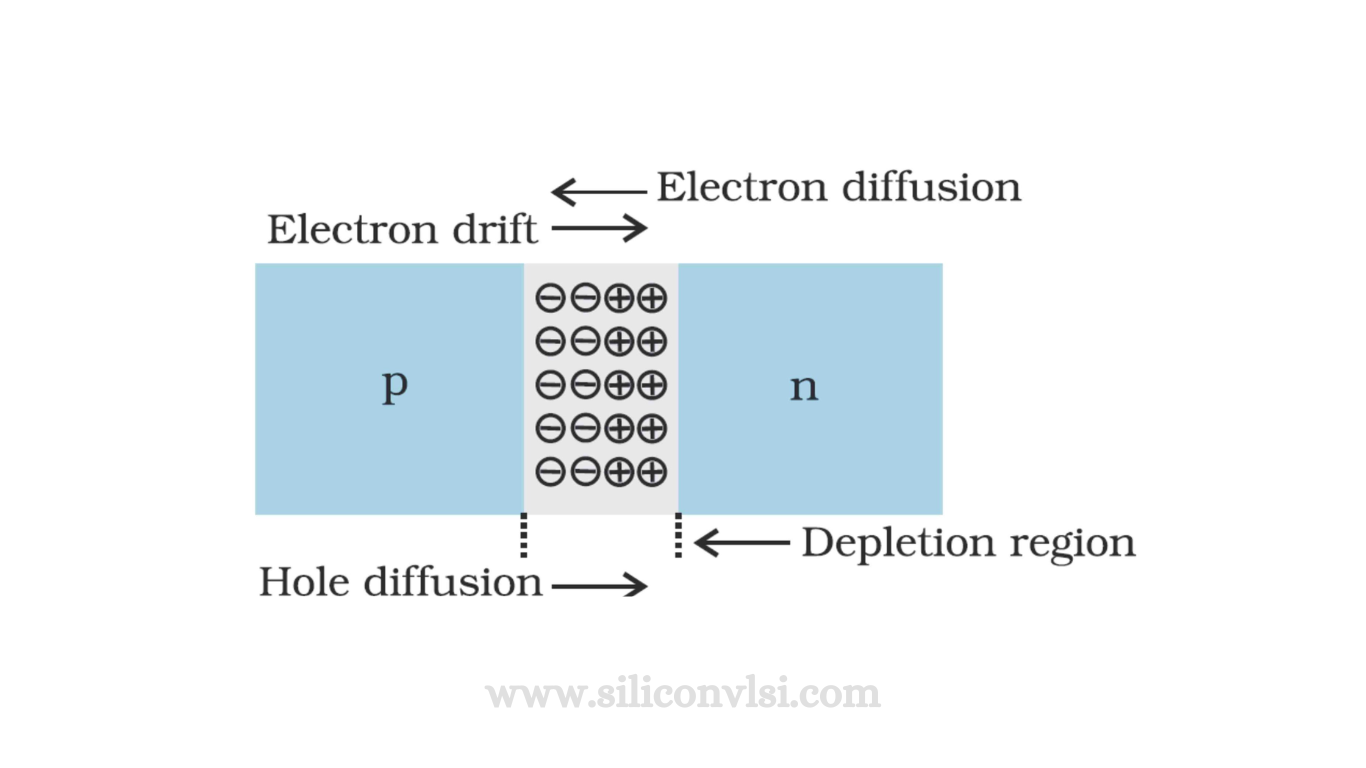
Drift and Diffusion in a PN Junction
Drift and diffusion become particularly important when studying a PN junction.
When p-type and n-type semiconductor regions are joined, the carrier concentrations are initially different across the junction.
This concentration difference causes carriers to diffuse:
- Electrons tend to diffuse from the n-side toward the p-side.
- Holes tend to diffuse from the p-side toward the n-side.
As carriers leave their original regions, charged ionized dopants remain behind. This creates a depletion region and an internal electric field.
That electric field produces a drift component.
Therefore, a PN junction naturally involves both:
Diffusion → caused by concentration gradient
and
Drift → caused by electric field
At thermal equilibrium, the net current is zero because the appropriate drift and diffusion components balance each other.
Drift vs Diffusion: Simple Example
Suppose a semiconductor contains a high concentration of electrons on the left and a lower concentration on the right.
Case 1: Concentration Gradient
Even without an externally applied electric field, electrons can move from the high-concentration region toward the low-concentration region.
This produces:
Diffusion current
Case 2: Electric Field
Now apply an electric field across the semiconductor.
The carriers experience an electric force and develop a net directional movement.
This produces:
Drift current
Case 3: Both Effects
In many practical semiconductor devices, both a concentration gradient and an electric field exist.
Therefore:
Total current = Drift current + Diffusion current
Why Are Drift and Diffusion Important in VLSI?
These mechanisms are fundamental to the operation of semiconductor devices used in VLSI.
They help explain:
- PN-junction behavior
- Diode current
- BJT operation
- MOSFET operation
- Carrier transport
- Depletion regions
- Semiconductor conductivity
- Junction leakage
- Device scaling
- Semiconductor device modeling
Understanding these mechanisms makes it easier to understand how voltage and carrier concentration influence current inside an integrated circuit.
Key Differences in One View
Remember this simple rule:
Diffusion Current
Concentration gradient → Carrier diffusion → Current
Drift Current
Electric field → Carrier drift → Current
And when both mechanisms are present:
Total semiconductor current = Drift component + Diffusion component
Frequently Asked Questions
What causes diffusion current?
Diffusion current is caused by a carrier concentration gradient. Carriers tend to move from regions of higher concentration toward regions of lower concentration.
What causes drift current?
Drift current is caused by an electric field acting on charge carriers.
Do electrons and holes both contribute to drift current?
Yes. Both electrons and holes can contribute to drift current.
Do electrons and holes both contribute to diffusion current?
Yes. Both types of charge carriers can produce diffusion current when concentration gradients exist.
Can diffusion current exist without an external electric field?
Yes. A carrier concentration gradient can produce diffusion current even when there is no externally applied electric field.
Can drift current exist without an externally applied electric field?
Yes. An internally generated electric field, such as the field in a PN-junction depletion region, can produce drift current.
What is the main difference between drift and diffusion?
The simplest way to remember it is:
Drift → electric field
Diffusion → concentration gradient
What is the total current in a semiconductor?
The total current can contain both components:
Total current = Drift current + Diffusion current
Key Takeaways
- Diffusion current results from a carrier concentration gradient.
- Carriers diffuse from regions of higher concentration toward lower concentration.
- Drift current results from an electric field acting on charge carriers.
- Electrons and holes can both participate in drift and diffusion.
- Carrier collisions create random thermal motion, while an electric field creates a net drift component.
- Both mechanisms are important in PN junctions and semiconductor devices.
- At PN-junction equilibrium, drift and diffusion components balance so that the net current is zero.
- Semiconductor current is often analyzed as the combination of drift and diffusion components.